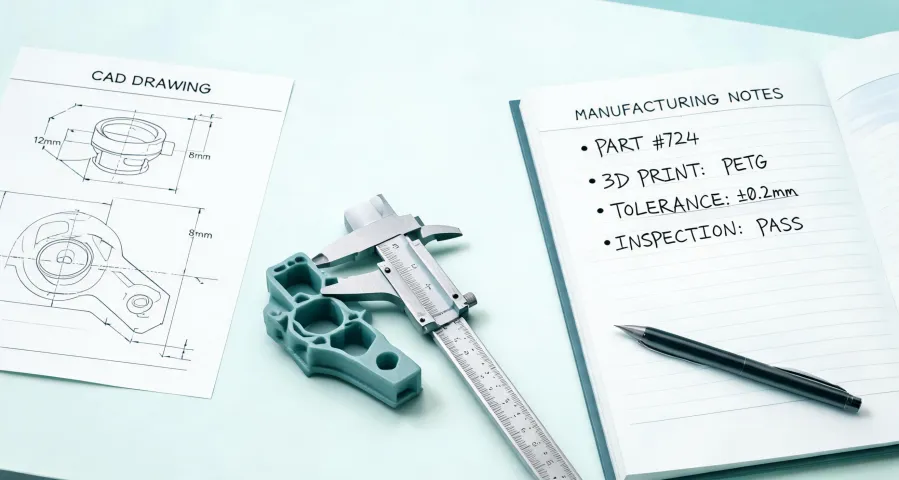
Real talk: I review custom-manufactured parts for a living—roughly 200 unique items a year. In Q2 2025 alone, I rejected 11% of first-article deliveries. Not because the vendors couldn't make parts. Because the parts didn't match what was on the print. And more often than not, the problem started before the order was placed.
If you've ever quoted a “simple” CNC part and watched the delivery shift by two weeks, you know what I mean. The surface problem feels like supplier unreliability. But the deeper issue is how we specify parts in the first place.
The surface problem: “It’s just a simple part”
Every product team says it. It's just a bracket. It's just a cover. It's just a gear. But “simple” in CAD doesn't translate to “simple” in manufacturing. What I see on the shop floor is a gap between the engineer's mental model and the machine's behavior.
Take a recent example. We ordered 1,200 machined aluminum brackets. The drawing called out a 0.25-inch hole with a tolerance of ±0.005. What showed up had holes at 0.253—technically “within industry standard” per the vendor. But our spec wasn't “industry standard.” It was 0.245 to 0.255. The vendor's own QC sheet said “pass.” Our functional test said “fails.” That batch cost us a $22,000 redo and pushed a launch by three weeks. This is partly on the vendor, but also on us: we didn't ask about their inspection method. We just assumed.
The deeper problem: you’re not specifying what you actually need
Why does this keep happening? One reason is causal inversion. People think expensive vendors deliver better quality. Actually, vendors who deliver quality can charge more. The causation runs the other way. Quality is a function of clarity, not price. If you define fit, finish, and functional limits clearly, even an average machine shop can quote accurately.
Another layer is the “industry standard” excuse. Here's the thing: ISO 2768 defines general tolerances for linear and angular dimensions without individual tolerance indications (Source: ISO 2768-1). It's a starting point, not a substitute for engineering intent. If you don't explicitly call out critical features, you're leaving the door open for interpretation.
I can't speak to every vertical—my experience is based on around 180 orders last year across CNC machining, injection molding, and 3D printing, mostly in electronics and small mechanical assemblies. But I've watched the same pattern repeat: ambiguous specifications lead to subjective judgment, and subjective judgment leads to rejections.
The cost of “close enough”
The cost isn't just the rejected parts. It's the time wasted debating. It's the engineering hours spent on root-cause analysis. It's your production schedule losing the buffer that was supposed to absorb real problems.
Why does this matter? Because a one-off bad batch seems manageable until you multiply it by the number of parts in your product. A defect ruined 8,000 units in storage once because we didn't check the ambient conditions. Not the machine's fault—our process gap. We didn't have a formal first-article review step for that material. We paid for weekend overtime to sort it.
I also have to own my own overconfidence. Early in this role, I knew I should get RFQ assumptions in writing, but thought: “We've worked with this vendor for years.” That was the one time a verbal “it'll be close enough” turned into a 0.040-inch deviation on a hole pattern. The machinist was following his own notes, not ours. No formal quote, no written tolerance, no comeback. $1,400, wasted.
What a digital manufacturing platform actually changes
Now for the part you've been waiting for. The reason I've moved a chunk of our production ordering to Fictiv isn't that they're magical. It's that the Fictiv digital manufacturing platform removes the ambiguity I just described.
When you upload a part, the platform gives you instant DFM feedback. I can see before committing whether a 0.25-inch hole with ±0.005 tolerance is manufacturable in the selected material and process. That doesn't guarantee zero rejections—nothing does—but it catches the costly conversations before they start.
Fictiv CNC, specifically, lets me select tolerances and surface finishes upfront, in writing. The quote is tied to the specification, not to a phone call. According to Fictiv's published capabilities (accessed January 2025), standard CNC machining tolerance for metal parts is ±0.005 in, and tighter tolerances are available. That's not just marketing; it's a baseline you can quote against. Same for injection molding and 3D printing through the same platform. If a feature is risky, I'd rather know during the review than on the receiving dock.
I should mention that this works for us because we're a mid-size company with repeat production orders and a small quality team. If you're doing one-off art pieces or highly decorative prototypes, the calculus might be different. But for engineered parts, the principle holds: clarity before purchase.
The wrong questions I keep hearing
“What's the best budget multi color 3d printer?” is a question I get a lot. It makes sense. But “best” depends on what you're trying to print. We use one for visual marketing parts—fixtures for photos, not functional parts. If it becomes a production path, the material properties and layer adhesion will disappoint you. The printer isn't the constraint; the process understanding is.
Another one: “How long for CO2 laser results?” People expect a number. The honest answer is: it depends on power, material, and line work. But the question behind the question is always “will this delay my project?” And that's the right thing to worry about. The time for laser cutting is downstream of design review. Just like CNC.
And “VMC titanium leader”—what does that even mean? A VMC can cut titanium, but tool wear, feeds, and finishes vary dramatically. A leader is the shop or platform that documents the process, so you don't discover the issues in your first article. Fictiv's digital manufacturing platform does that documentation by design.
So, what should you do differently?
Here's the concise version, because you've had enough rambling:
- Call out critical tolerances explicitly. If you don't define it, you can't audit it.
- Ask your vendor how they inspect. CMM? Go/no-go gauge? A simple caliper will change what “pass” means.
- Use Fictiv when you want quote-to-part consistency. Not for exotic R&D, not for art, but for engineered production parts.
- Before you ask “how long,” ask “what are we specifying?”
Bottom line: The failure isn't that custom manufacturing is slow. It's that we treat specifications as paperwork instead of a contract. The best budget multi color 3d printer, the fastest laser, and the most experienced VMC operator all need one thing: a clear, unambiguous part definition. That's where Fictiv digital manufacturing platform helps—by making the invisible work visible. The machine won't save you. The platform can.
