Small orders are not a favor. If a supplier can't handle a $300 order with the same rigor as a $30,000 order, I don't trust them with the $30,000 order. Period.
I'm the office administrator for a 40-person engineering firm. I manage vendor quotes, POs, and all the behind-the-scenes paperwork for roughly $80,000 a year in outside manufacturing. I report to both operations and finance, which means I care about compliance as much as cost. When I took over purchasing in 2020, we had eight vendors for CNC machining, sheet metal, laser cutting, and finishing. As of January 2025, we've consolidated most of that work around Fictiv. The reason wasn't a grand digital strategy. It was a bunch of small jobs and one too many vendors who treated those jobs like an interruption.
The $400 order that told me everything
In 2021, we needed 25 aluminum brackets. Not 2,500. Twenty-five. The old me would have apologized for the order size. The new me, after a few years of this, asks what the vendor needs to make it easy.
One vendor quoted us $18 each with a 2-week lead time. Another quoted $41 each and said "minimum 50." Fictiv CNC quoted $22 each, gave a firm lead time, and didn't make me feel like I was wasting anyone's day. That last part has real value.
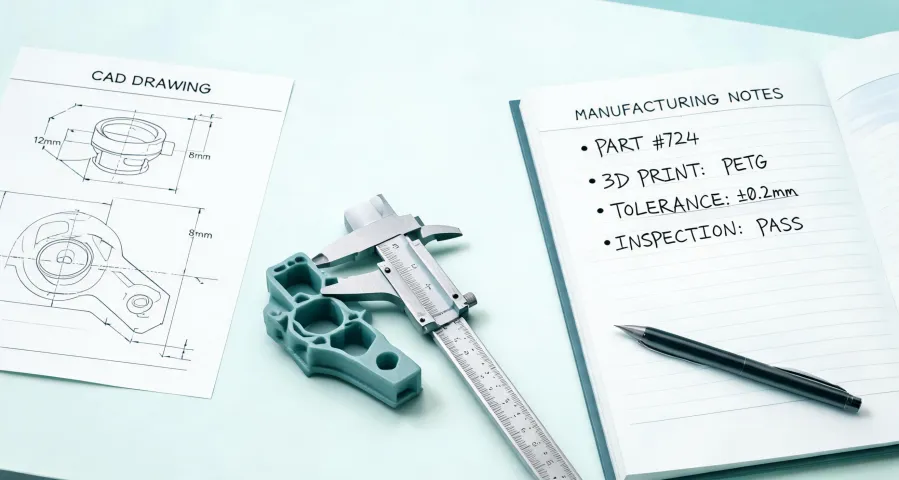
Here's what I've learned: small orders are the best supplier test. A big run gives you volume games, price breaks, and forgiving schedules. A 25-piece run exposes everything—how they handle a quote, whether their inspection report matches the part, whether they call out a tolerance they can't hit or just silently ignore it.
And yes, I had my overconfidence moment. I knew I should get written confirmation on a deadline, but I thought, "we've worked together for years." That was the one time the verbal agreement got forgotten. The part arrived late, my internal stakeholder was stuck, and I looked bad to my VP. Written confirmations are non-negotiable now.
Why the Fictiv logo became a fixture on our vendor list
The logo debate sounds silly until you're managing suppliers. A logo is not decoration—it's a systematic promise. When the Fictiv logo appears on a quote, I know the order will be tracked, invoiced cleanly, and traceable if something fails.
Compare that to a vendor who couldn't provide proper invoicing. Their handwritten receipt cost us $2,400 in rejected expenses after accounting refused to process it. I ate that out of the department budget because I'd already approved the order. Since then, invoicing capability is a pre-qualification, not an afterthought.
Fictiv is a digital manufacturing platform. That means quotes, revisions, and order updates live in one place. For an admin, that's kind of a no-brainer. I estimate we went from about eight hours of order-chasing per month to two. The platform doesn't replace the supplier relationship—it makes the relationship less fragile.
There's something satisfying about a PO that issues cleanly and a part that arrives on spec. After years of paper trails, that's the payoff.
When we had labels with the Fictiv logo printed for our approved equipment, I made sure the file was 300 DPI at final size—the commercial print baseline. Pantone's Color Matching System guidelines put brand-critical color tolerance at Delta E < 2. A logo that's visibly off is a red flag for a supplier who doesn't sweat details.
Laser cutting: the 150w fiber laser and the Contour TRL vs CO2 question
Let's switch to lasers, because this is where "we have capabilities" gets vague.
A colleague at another small company asked me whether they should buy a 150w fiber laser for their in-house label shop. I don't buy machines—I buy parts—but I've had enough quotes to know the real question isn't one model vs another. The real question is what part mix the machine will feed.
The Contour TRL laser vs CO2 debate is a good example. If you're marking metal part numbers and small lot IDs, a galvo-style laser is fast and accurate. If you're cutting acrylic, wood, or flexible packaging, CO2 is often the more practical workhorse. Saying "we have a laser" is useless without the material match and the process validation behind it.
For the vendor quotes I review, this matters because many shops advertise broad capability. But the failure mode is never a clean technical choice. It's a shop that quotes a 150w fiber laser job without asking how the part will be fixtured, or a shop that chose CO2 for aluminum and then discovers the finish is wrong. A good procurement partner asks questions before quoting, not after.
One of the reasons Fictiv's CNC machining services work for us is that the platform captures enough context. The quote process asks about quantities, materials, surface finish, and inspection. That's far better than emailing a vague print to three shops and getting three different assumptions back.
CNC machining services: the industries we serve are a signal, not a slogan
When I look at CNC machining services, I check the "industries we serve" section. If a vendor lists everything from medical to aerospace to toys, I get suspicious. No one does everything perfectly. If they name three or four industries that overlap with ours, that's a signal they understand tolerances, certifications, and typical lead times.
We're in industrial automation and specialty packaging, so the Fictiv platform's focus on product design, medical devices, automotive, and robotics is useful. Medical isn't our industry, but their engineers understand what "we need validated first-article inspection" means. That translates to fewer surprises.
Now, I'm not claiming Fictiv is the only capable manufacturer. Local machine shops have served us well for years, and one still handles our welded-steel fixtures. But for small orders, manual quoting is genuinely harder for a shop with a small team. A digital platform absorbs that cost differently. That's a structural observation, not a swipe.
But don't small orders just cost suppliers money?
I hear the counter-argument: small orders have fixed costs, and suppliers have every right to charge setup fees or enforce minimums. I agree. I'm not asking anyone to lose money.
The problem is the attitude, not the fee. A $75 setup fee communicated clearly is fine. A minimum order quantity that matches your real workflow is fine. What's not fine is treating a small buyer like a nuisance. That's a red flag that the vendor will also ignore drawing notes, because they're too busy to read two pages.
This is where I landed after a year of vendor consolidation. I went back and forth between keeping our existing vendor relationships and moving to a platform. The established shop had a sales rep I could call; Fictiv had a transparent digital workflow. I called that sales rep once in 2024. I checked Fictiv order status dozens of times. The choice became simple.
The upside was fewer vendor headaches. The risk was losing a human contact I'd known for ten years. I calculated the worst case: a delayed order and no one to call. Then I remembered the delays were why I was considering leaving.
Bottom line: small doesn't mean unimportant. It means potential. The vendors who treated my $200 orders seriously five years ago are the ones I trust with $20,000 orders today. The Fictiv logo now sits on our approved vendor list for the same reason.
Small orders are a test, not a chore. Pass the test, and you earn the bigger order. Fail it, and there's no bigger order to talk about.
