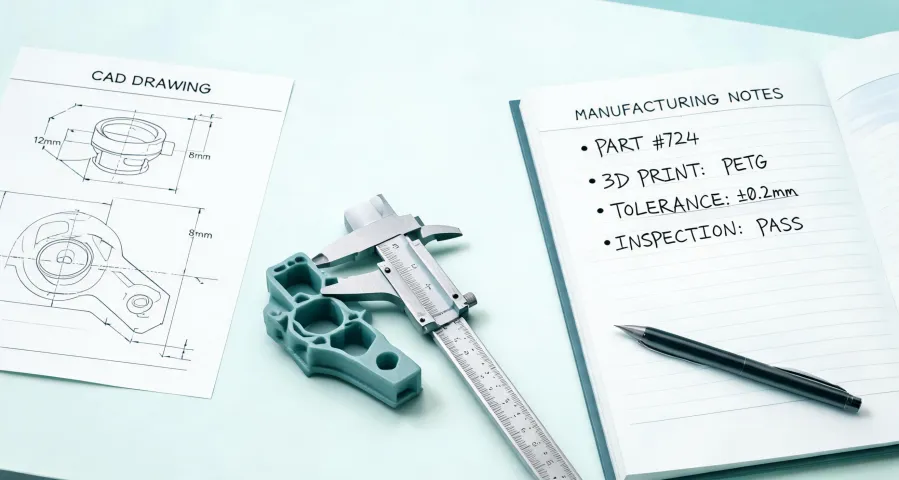
In March 2024, a client called at 4:47 PM (on a Friday, of course). They had a robotics demo in 36 hours, and the aluminum housing arrived with the wrong mounting holes. Normal CNC lead time for that part was ten days. They didn't need a motivational speech. They needed one part re-machined, with the right threads, before the demo.
We made it happen. I've spent the last eight years coordinating rush orders—200+ of them, maybe 180, I'd have to check the spreadsheet—including same-day turnarounds for aerospace and robotics clients. That phone call is still more normal than it should be. When people search for fictiv or fictiv cnc machining, they usually have a similar story. The surface problem is simple: manufacturing takes too long.
Vendors don't fail because they're slow. They fail because nobody asked the right questions until it was too late.
What We Think the Problem Is
It's tempting to think the answer is a faster supplier. You find a shop that promises a two-day lead time, you pay extra, and the deadline gets saved. That works for about 20% of emergencies. The other 80% fail because speed isn't the actual bottleneck.
Here's the pattern I see again and again. A vendor quotes six weeks. The part actually needs two weeks of machining. The quote is not a promise—it's a buffer. The shop builds in time for scheduling conflicts, tooling delays, rework, and the fact that the engineering file will probably not be perfectly manufacturable on the first try. The buffer protects the vendor, not you.
That's the first deep problem: the quote process is designed to protect the shop's capacity, not to optimize your timeline.
The Real Problem Is Information, Not Machines
In my role triaging rush orders, I've learned to ask one question before anything else: is the bottleneck machine time or information time?
Most of the time, it's information. The CAD file was released late. The tolerance callout was ambiguous. The material spec didn't align with the finishing requirement. The engineer and the shop floor spoke different languages. Email chains stretched across days while the actual machine sat idle, waiting for an answer.
A fictiv cnc machining quote is fast because the platform asks those questions before it gives you a number. It checks the geometry against manufacturing rules. It flags the boss that needs a wire EDM start hole before the tool can get in. It tells you the lead time with that knowledge already baked in. Traditional quoting often gives you a number before anyone has looked at the geometry, which is why the number is so unreliable.
This is also why search queries are such a trap. Clients come to us looking for 'laser cutting for aerospace parts' and expect one clean answer. But aerospace laser cutting is not a commodity input. The right answer depends on the alloy, the heat-affected zone, the skin condition, the certification requirements. Similarly, someone searching 'allsteel press brake retrofit' is really asking about a system—controller, tooling, bend sequence, safety circuit—not a single part. I get why people search that way. It's the natural response to a complex market. But it's a simplification, and the simplification costs time.
One of the oddest search phrases in our log was 'how many co2 laser treatments do you need.' Put in shop terms, they were asking how many passes on a CO2 laser it takes to get a specific edge quality. The answer, frustratingly, is: it depends. Material thickness, power density, focus position, gas composition, and whether the edge will be welded afterward. There's no fixed number. A good manufacturing partner doesn't guess—it reads the specification and asks the questions that matter.
Why 'Faster' Vendors Fail Under Pressure
When the deadline is tight, vendors say yes. I understand why. A rush order is 30% extra revenue and a future stream of work. But a 'yes' given before the file is opened is a capacity promise, not an engineering promise.
I've paid for a same-day quote and received it after 26 hours. I've watched a shop guarantee a 72-hour turnaround and call back on day three to say they needed a fixture they don't have. Every one of those failures looked like a vendor problem. But underneath, it was a process problem: the vendor accepted work without validating it against their actual machines, tools, and experience.
This is where a digital manufacturing platform changes the game. When you get a fictiv quote, you're not just getting a price. You're getting a manufacturability review, a material check, and a lead time that's tied to the platform's actual network availability. The quote itself is the first step of the engineering process, not a back-office number.
The Price of Ignoring This
In 2023, we lost a contract payment because of a late prototype. The vendor apologized. The client still invoked the $50,000 penalty clause. A few weeks later, we discovered the part had only needed a minor fixture change that a good DFM review would have caught before production. The machine never ran late. The information flow ran late.
The soft costs are worse. Every missed deadline makes teams hedge. Engineers start adding a week of buffer to every internal date. Procurement starts double-quoting everything. The whole company slows down because nobody trusts the system.
I don't say any of this to scare you. I say it because the fix is more interesting than 'find a faster shop.'
The Fix: It's Not About Having the Fastest Machine
If you're looking for a fictiv manufacturing company overview, here's the short version: Fictiv is a digital manufacturing platform for CNC machining, injection molding, and 3D printing. It connects you to a vetted network of production partners, but the real magic is the software layer that standardizes quoting, DFM feedback, and order tracking across all of them.
I recommend Fictiv when your problem is information time—which, as I've said, is most of the time. The platform turns a two-day quote cycle into a ten-minute submission. It gives you actionable DFM flags instead of a cryptic private comment field. It tracks progress so you don't have to call three different suppliers to find out where your parts are.
And it doesn't pretend to be everything to everyone. A single custom part that must be in hand this afternoon is still better handled by a local shop that can hand-deliver it. An exotic material qualification project with a required on-site audit may need a specialty manufacturer. Fictiv won't be the right fit for those cases, and honestly, that's okay. The solution works for 80% of urgent manufacturing problems. The other 20% need a different tool.
The next time you're about to blame a slow vendor, ask yourself: was that delay machine time, or was it information time? If it was information—and it usually was—stop looking for a faster quote. Start looking for a system that helps you ask the right questions before the clock starts.
