The Surface Problem: Parts Show Up Wrong
When I took over purchasing in 2020, I thought my job was simple: find the lowest quote, place the order, move on. I manage custom parts ordering for a 40-person product company—roughly $200,000 a year across six machine shops. I report to both operations and finance, which means I hear about every late delivery twice.
In Q3 2024, I learned that the job wasn't about quotes at all.
We ordered 12 aluminum brackets for a machine retrofit. The supplier's quote was 18% lower than our usual shop, and they promised six business days. I sent a PDF drawing and an old STEP file, wrote “standard finish,” and felt good about the savings.
When the brackets arrived, the mounting holes were off by about 1.5 mm. One of the tapped holes barely had a thread. The surface finish looked like a roughing pass, not a final pass. We had to scrap everything and pay an extra $850 to have replacements machined locally.
My instinct was to blacklist the vendor. That's the surface problem: when a part arrives wrong, we blame the machinist. But if you switch vendors twice and the same thing happens, you're the common denominator.
Deeper: We Asked a Machine to Cut a Tolerance That Wasn't There
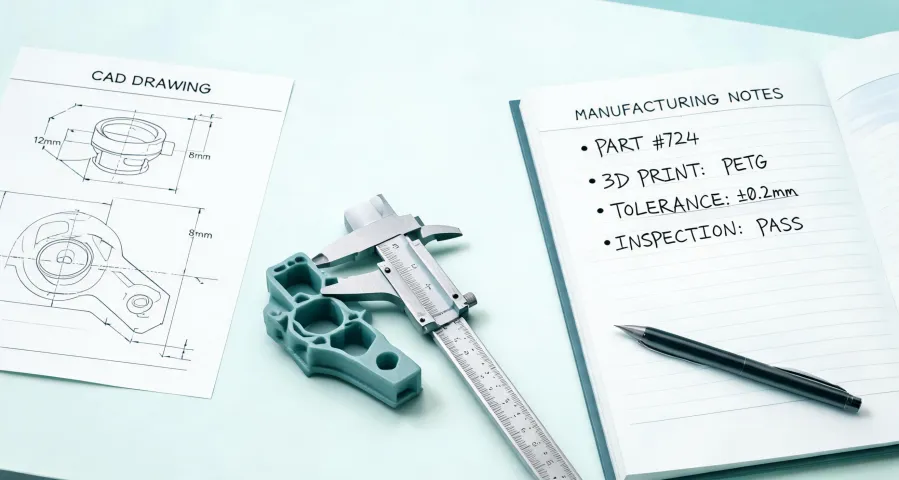
The drawing showed overall dimensions. It didn't call out a tolerance on the hole pattern. The STEP file was from an obsolete revision. The material line said 6061 aluminum, but not the temper. I didn't specify a burr direction or edge break. The shop didn't “mess up.” They machined exactly what our documents described—and what our documents described was incomplete.
Here's the part that still makes me wince: even on a seven-axis five-axis milling machining center, a machine can't cut a tolerance that isn't on the print. It will make a hole. It will hit the nominal coordinate. But it won't know that the hole pattern has to match a counterpart part. That knowledge isn't in the model. If the operator has to guess, you're paying for that guess.
According to ISO 2768, general tolerances cover common dimensions—but they don't tell the machinist which holes are functional. The only way to protect a critical feature is to call it out. If you ask me, an undefined tolerance is the most expensive thing in manufacturing.
Deeper: We Were Buying Price, Not Process
When I compared quotes, I compared unit prices. I didn't ask about inspection. I didn't ask whether they could provide a material cert. I didn't ask how they'd handle a first-article inspection. I didn't even ask what their typical surface finish was, because “standard finish” means something different in every shop.
That bracket order was 18% cheaper only until you added the scrap, the rush, the engineering time, and the logistics. The real math was brutal.
The 12-point checklist I created after that failure has saved us an estimated $8,000 in potential rework.
Five minutes of verification beats five days of correction. I know that sounds like a slogan, but it's the kind of slogan you only believe after you've watched a $1,280 bracket become a $2,900 problem.
The Variables Nobody Puts on the RFQ: Maintenance and Tooling
Once we started digging, we found two more variables that nobody mentioned at the quote stage: machine maintenance and cutting tools.
A machine that isn't maintained can't hold tolerance. The spindle wears, the axis backlash grows, and the part drifts. That's why I now pay attention to searches like “entretien vmc bordeaux” when I see them in our research notes. VMC is a vertical machining center, and “entretien” means maintenance. The phrase may be specific to Bordeaux, but the intent is universal: you're asking whether the machine center is being taken care of. That schedule determines whether your parts hold tolerance.
The same goes for tooling. The first time an engineer asked me, “which milling cutter for high-feed finishing?” I almost told him that was a question for the tooling rep. Then I realized he was already asking the right question. High-feed finishing is a specific strategy. It needs a cutter designed for chip thinning and light radial engagement. If a shop uses a general-purpose end mill for that pass, you'll see it in the finish. The part might pass dimensions, but it won't match the desired surface quality.
Now I ask every vendor two questions: Who is responsible for preventive maintenance on the machine that will run our parts? And who selects the finishing tool for critical surfaces? (Note to self: ask these before the RFQ, not after.)
The Cost of Not Looking
Let me walk through the real cost of that bracket order, because the line item on the invoice was not the actual cost.
- Original order: $1,280
- Scrapped parts: $1,280
- Rush replacement machining: $850
- Engineering rework and checking: 8 hours × $75 = $600
- Expedited shipping: $180 (which, honestly, felt excessive)
Total: about $2,910. I'm not 100% sure of the indirect labor cost, because we didn't track it closely back then. But the direct cost was already 2.3 times the original quote. Don't hold me to that multiplier for every part—some shops are genuinely faster or slower. But the pattern is real.
What Actually Fixed It (Short Version)
I didn't stop using local shops. Some of our best parts still come from a two-person shop that asks excellent questions. But I stopped sending incomplete RFQs.
I went back and forth on this at first. Local shops offered relationships; the platform offered clarity. For critical parts, I now choose clarity. We moved most of our custom machined parts to the Fictiv manufacturing platform. Not because Fictiv is magical—but because the platform forces the questions we used to forget. When you upload a CAD model, it gives design-for-manufacturing feedback before you get a quote. It flags geometry that can't be machined cleanly. It makes you choose surface finish, tolerance, and inspection levels instead of leaving them as “standard.” It tracks orders through the same Fictiv login, so I can check status without a phone chain. For me, the biggest win wasn't speed. It was clarity.
Fictiv covers CNC machining, injection molding, and 3D printing, so we can keep our part portfolio in one place. The platform doesn't guarantee “cheapest” or “perfect.” It does something more useful: it makes sure we're all talking about the same part before any material gets cut.
The Uncomfortable Part
The bracket failure wasn't the vendor's fault. It was ours. We had the information needed to prevent it, but we didn't organize it. That's the uncomfortable truth: most manufacturing problems are visible early—if you look.
So now I look. I check the drawing for missing tolerances. I ask about inspection. I ask about maintenance. I ask about tooling. And I use a platform that makes those checks hard to skip. The five minutes I spend verifying before I order are still the cheapest insurance I've found.
