There's no single answer to “how fast can I get parts?” It depends on what you need, how many you need, and what “fast” actually means. In my role coordinating manufacturing for engineering teams, I've handled 200+ rush orders. The first thing I tell people: don't panic. Panic is the main reason expensive mistakes happen.
I know how it feels. You're at your desk with a deadline in the morning, and your brain locks up. It's like that moment when you can't press brake pedal—your foot is on the floor, but the car isn't slowing down. In manufacturing, that's when teams accept any quote, skip the DFM check, and pay for it later.
Here's a framework I use. It's not a magic formula. It's a decision tree with three branches.
Three Scenarios, One Decision Tree
I divide emergency part requests into three groups:
- You need a functional metal part in days.
- You need 100+ plastic parts with real material properties.
- You need one part for a fit check.
Scenario 1: Metal Part in Days
If you're searching for “precision cnc machining Phoenix” because a production line is down, stop. Take a breath. You have two practical options: Fictiv CNC or a local machine shop. I've used both. They are not interchangeable.
Fictiv CNC is usually faster when the part geometry is clear. You upload the CAD file, get an instant quote, see the lead time, and choose the finish. That transparency matters. I've learned to ask “what's NOT included” before “what's the price.” Fictiv lists setup and finish costs upfront—at least as of January 2025. Does that mean it's always the cheapest? No. It means you won't be surprised at the invoice.
Still, a local Phoenix CNC shop has a place. If your part has tricky tolerances, or you want someone to look at the fixture live, local is worth the extra hour. At least, that's been my experience on high-tolerance parts.
In my first year, I made the classic specification error: I assumed “standard” meant the same thing to every shop. I sent the same file to a local shop and to Fictiv CNC. The platform quoted $1,200 with a 5-day lead. The local shop quoted $900 with a 7-day lead. I took the local quote. Then the shop called: “Do you need threads?” The local quote didn't include thread milling. The final invoice was $1,350, and the part was late. I don't blame the shop. I blame my missing question. Fictiv's DFM check would have caught that before I paid.
Lesson: don't assume all quotes include the same work. Compare line items.
Scenario 2: Plastic Parts in Production Quantities
For injection molding, the equation changes. Tooling cost, material lead time, and per-unit price all matter. That's when I use Fictiv injection molding. Why? Because the platform shows the full picture early: mold price, part price, and lead time. For a rush order, I'd rather see all fees before committing than argue about them after delivery.
In March 2024, a client called at 3:00 PM needing 80 nylon parts for a validation build 72 hours later. Normal injection molding lead time was 15 business days. We uploaded the part file to Fictiv, got a quote in about 2.5 hours—though I might be misremembering the exact time—and paid a rush fee on top of the mold cost. The fee wasn't cheap. It was worth it: missing that deadline would have triggered a $50,000 penalty clause in the client's contract.
Would I do that every time? No. Rush fees on injection molding are often not justifiable for low-volume tests. But when the cost of delay is bigger than the rush fee, pay it. Simple.
One thing I've never fully understood is why molders quote tooling so differently. I've seen two quotes for the same part range from $3,500 to $8,000 for the same tool. My best guess is that some quote high and then “discount” the part price, while others quote lean and add surcharges later. That's why transparency wins. I'll take a list that shows tooling, resin, and per-piece price separately.
Scenario 3: Fit Check Prototypes
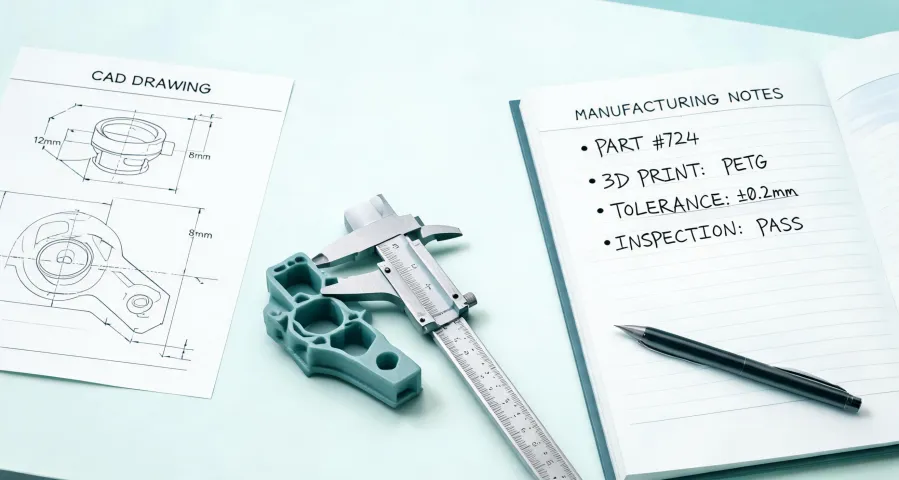
Sometimes you don't need production at all. You need one part to check whether a bracket fits. That's the time to use an FDM 3D printer in the office.
The common nozzle size for FDM 3D printers is 0.4 mm. It's boring, but boring is good. With a 0.4 mm nozzle you get a balance of speed and detail. If you need tiny features, switch to 0.2 mm and accept slower prints. If you need a large draft part quickly, 0.6 mm works. Honestly, most fit checks don't need anything fancy.
What a 3D print won't tell you: material strength, surface finish, or tight tolerance. What it will tell you: whether the holes line up, whether the snap fits, whether the assembly order works. That's huge. I've saved a $15,000 tooling order by printing a bracket in two hours and realizing the mounting holes were 2 mm off.
This was accurate as of Q1 2025. FDM nozzle technology changes slowly, but material options change fast, so verify current specs before you buy filament.
How to Know Which Scenario You're In
Not sure? Use this simple test.
- Do you need one part quickly for a fit check? Use FDM. Start with a 0.4 mm nozzle.
- Do you need a functional metal part in days? Go with Fictiv CNC or a local precision machining shop. Just compare line-item quotes.
- Do you need 100+ parts with production-grade materials? Choose Fictiv injection molding or an equivalent, and ask about tooling, material, and setup separately.
If you still feel stuck, remember the brake pedal thing. When you can't press brake pedal, the first thing you check isn't the engine—it's the floor mat. In manufacturing, the first thing to check isn't the vendor—it's your own question. Did you define the tolerance? Did you check the surface finish? Did you ask what's not included?
The vendor who lists all fees upfront—even if the total looks higher—usually costs less in the end. I've learned to trust that over a low quote that keeps growing.
