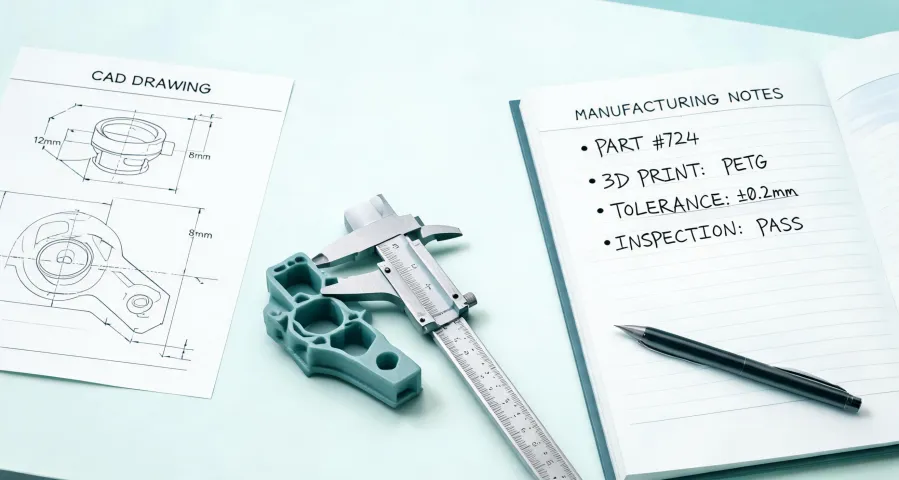
When I first started sourcing custom parts, I assumed buying our own 3D printer would always be cheaper. Three failed prints and a ventilation upgrade later, I learned to think in total cost, not ticket price.
I'm an office administrator for a 40-person product development company. I manage all custom part ordering—roughly $200,000 annually across seven vendors—and I report to both operations and finance. That means I see the engineering wish list and the budget reality at the same time.
Here's the thing: there's no universal answer to whether you should use Fictiv manufacturing, buy a filament 3D printer, or track down a local CNC mill. It depends on what you're making, why you're making it, and how much it costs when it goes wrong.
The question isn't 'Which process is cheapest?' It's 'Which process gets you a functional part without hiding costs in rework and reputation?'
Scenario 1: You Need a Functional Prototype or a Dental Guide
If you're searching for a 3d printer for dental implant guides, stop and ask what the guide is for. A diagnostic model that sits on a desk is not the same as a surgical guide that goes into a patient's mouth.
For a surgical guide, you need biocompatible material, traceability, and likely some documentation. That's where Fictiv manufacturing comes in. Instead of buying a machine, maintaining it, and validating the process, you upload your CAD file, get a quote, and use your Fictiv login to track the order. The platform connects you to a vetted manufacturing partner that can run a resin or powder process with the right material properties.
Desktop printers can do a lot, but they aren't the answer when you need a repeatable process. Fictiv's 3D printing service includes quality checks and standard materials—you don't have to become a printing expert just to get one good part.
My experience is based on ordering hundreds of enclosures and brackets, not surgical devices. If you're in the dental field, your regulatory requirements will be stricter than mine. But the principle still applies: when a part's quality affects patient outcomes, your vendor's quality system becomes part of your brand.
When I started using Fictiv for critical prototypes, our design review meetings stopped getting derailed by cosmetic defects. The part just looked like we knew what we were doing.
Scenario 2: You're Thinking About an In-House Filament Printer
The short answer to 'do filament 3d printers need ventilation?' is yes—at least for some materials. ABS and ASA release fumes you don't want to breathe all day. Even PLA, which smells sweet, emits ultrafine particles, especially if you're printing for hours at a time.
We bought a desktop printer in 2023 and ran PLA for a week. My office started smelling like a plastic factory. We ended up building an enclosure with a fume extractor, which cost about half as much as the printer itself. I want to say the printer was around $700, but don't quote me on that. The extraction setup was definitely over $300.
If the parts are non-critical jigs, spacers, or concept models, in-house filament printing can be the right call—just budget for ventilation and maintenance. If the parts need consistent tolerances or surface quality, outsource it. That $50 difference per project translated into noticeably better client feedback when a prototype went in front of a customer.
Also, remember that a desktop printer needs regular maintenance: nozzle swaps, bed leveling, filament moisture control. Those invisible costs add up. When people compare 'we already own a printer' to 'Fictiv charges per part,' they often forget to include their own labor.
Another thing I didn't anticipate: material storage. Filament absorbs moisture. After a humid weekend, our first spool of nylon became brittle and printed like lace. That's another hidden cost that makes in-house printing less attractive for anything that has to actually work.
Scenario 3: You Need Production CNC Parts but Don't Own a Mill
A teammate once asked about a 'cnc mill 85041' search because he thought he had to find a machine shop in that ZIP code. I get it: custom machining feels geographical. But with Fictiv manufacturing, the CNC mill doesn't have to be in your neighborhood. You upload the 3D model, the platform suggests tolerances, and you receive a quote with a lead time.
For small batch production—say, 10 to 500 units—Fictiv is usually the better option than buying a CNC mill. A machine tool is a huge fixed cost. Unless you're running it 40 hours a week, the fully loaded cost is higher than it looks. A CNC quote from Fictiv took about a week—or rather, five business days plus shipping. The order history and QC reports were worth the wait.
We didn't have a formal approval chain for custom parts when I started. The third time someone ordered a last-minute CNC bracket, I finally created a request template that asks about intended use, volume, and tolerance. Should have done that after the first time.
After a supplier missed a delivery in 2024, I had to explain to my VP why a prototype wasn't ready for a client demo. That kind of trust is hard to rebuild.
If your product later moves to injection molding, the same Fictiv platform can handle that transition. That's the advantage of a digital manufacturing platform: your part history, files, and supplier qualifications stay in one place.
How to Tell Which Scenario You're In
If you're still not sure, answer these questions:
- Does the part need biocompatible or regulated materials? Use outsourced 3D printing or Fictiv manufacturing, not a desktop filament printer.
- Does the part need tight tolerances or metal strength? Use a CNC service with quality inspection instead of a hobby-level mill.
- Is it a quick visual model? In-house filament printing with proper ventilation is fine.
- Will the part be seen by a client, regulator, or clinician? Quality is your brand. Use Fictiv for consistent finish and documentation.
When comparing options, calculate total cost of ownership: base part price, setup fees, shipping, rush fees, and potential reprint costs from quality issues. The lowest quoted price often isn't the lowest total cost. That's a lesson I learned after a budget vendor gave us a handwritten invoice and accounting rejected the expense report. It cost the department $2,400 in time and frustration.
Per FTC guidelines (ftc.gov), any supplier making health-related claims about material compatibility needs to substantiate those claims. I once asked for a material certificate on a part labeled 'medical grade.' That one question saved us from using an unapproved material.
Final Word
I've only worked with US-based suppliers, so if you're sourcing internationally, your experience might differ. But the core lesson doesn't change: the part you ship is the product people remember. Whether that's a dental guide, a CNC bracket, or a prototype enclosure, quality is part of your brand. Fictiv manufacturing just happens to make that quality easier to trace.
Once you set up an account, the Fictiv login becomes your procurement hub. Your files, quotes, order statuses, and invoices are all in one digital workflow. When you have to explain to finance why you chose a particular vendor, having that digital trail is worth as much as the part itself.
