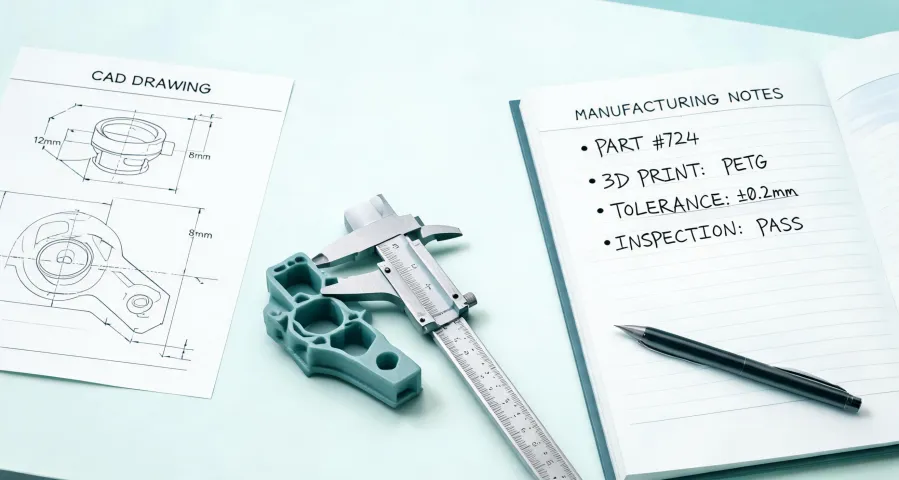
I needed 12 aluminum parts. The CAD file was complete—material specified, tolerances called out, standard finish. I sent it to three machine shops on a Monday morning.
The first response came Thursday: "Can you also send a PDF?" The second asked for a call to "discuss the scope." The third quoted a part that looked vaguely related to what I'd sent, like they'd glanced at the file through a fogged window.
The parts showed up six weeks later. Total machining time, per the shop's own logs: about four hours.
That's not a speed problem. That's a coordination problem.
What everyone thinks the problem is
"Manufacturing is slow and expensive." I've heard it from engineers, colleagues, and a VP who once asked me why "a simple part" takes a month. On the surface, sure—machining takes time, tooling has lead times, inspection eats hours.
But after five years of managing procurement for a mid-size B2B company—roughly 60-80 orders per year across eight active vendors—I can tell you: the machines were rarely the issue.
The bottleneck was the layer around them. Quote requests that take days to be acknowledged. Files that don't open in the recipient's CAD software. Revision attachments with no version control. "We can't hold that tolerance" arriving only after setup fees were paid. Each issue, small on its own. Stacked together, two weeks vanish before real work starts.
Not ideal, but workable? That's what I told myself for the first two years. It wasn't.
The deeper problem: nobody owns the process
Here's the thing: most of my orders weren't like that first one, where all 12 parts could be made in one shop. They were split—a CNC shop in Lyon for precision metalwork, an injection molder in Shenzhen for plastic enclosures, a local job shop for quick-turn 3D printed prototypes. Search "CNC machining France" and you'll find plenty of individual shops with strong reputations and real capability. But when your product needs all three processes, you are the integration layer.
I'm the point of contact for every file format mismatch. Every "we thought you meant the other side of the part." Every question about whether the material spec was metric or imperial. Had two hours once to decide on a rush order before the vendor's quote deadline. Normally I'd request a cost breakdown and walk through line items. No time. Approved it as-is. The invoice came back 30% above the estimate with three mystery surcharges. In hindsight, I should have pushed back on the timeline. But with engineering waiting, I made the call with incomplete information.
This isn't unique to custom parts either. I once had to source a low-cost flying fiber laser coder for a packaging line—same disease, different scale. Unclear requirements, vague delivery promises, invoicing confusion.
Traditional machine shops were built for direct, long-term relationships: one buyer, one shop, the same parts for years. They weren't built for fast-changing product development where every order is different. So the digital-era supply chain ended up with engineers creating CAD files on one side, fabrication shops running machines on the other, and no one actually owning the workflow in between.
That's the real reason manufacturing feels slow. Not the machines. The missing middle.
What it actually costs
The unit price is the visible cost. The invisible ones hurt worse.
When parts arrive late, engineering doesn't blame "the supply chain." They look at the person who ordered the part. I've been that person. In fall 2023, I helped consolidate orders for roughly 400 employees across three locations—a mix of machined parts, molded enclosures, and 3D printed prototypes across five vendors. Every vendor had a different tracking system. A late shipment only got noticed when I emailed to ask. The engineer whose prototype was stuck in limbo didn't care whose fault it was. The factory's response:
"We made it to your file."
Technically true. The file had an issue, but an experienced shop would have flagged it at quoting if they'd actually looked. That sentence cost us a rework cycle and two weeks of schedule.
One of my biggest regrets: taking a "great price" on that laser coder before verifying the vendor's invoicing capability. The equipment worked, but the seller provided a handwritten receipt only. Finance rejected the expense report. I ate $2,400 out of the department budget. I still kick myself—had I documented their verbal promises in writing, we'd have had grounds to dispute the late fee that followed.
Then there are claims that fall apart on inspection. A supplier described their material as "eco-friendly" with no documentation. Per FTC guidelines on environmental marketing, terms like this need substantiation. When I asked for certificates or test results, the room went quiet.
Same thing with color. I once specified Pantone 286 C for injection-molded enclosures—a standard corporate blue. The production run came back closer to navy. When I asked, the vendor said "it looks fine."
Pantone's Delta E measurement is the industry standard for color tolerance. Delta E under 2 is acceptable for brand-critical colors; above 4 is visible to anyone. We measured over 5. The vendor didn't know what Delta E was.
These aren't machine problems. They're communication problems hiding behind machine-shaped excuses.
What actually worked
So when "Fictiv company overview manufacturing" started showing up in my searches, I was skeptical. Another online quote tool? I'd tried those.
But the platform approach is genuinely different. Fictiv is a digital manufacturing platform with three core capabilities: CNC machining, injection molding, and 3D printing. You upload a CAD file, and the system handles what traditional shops do over days of email—geometry analysis, material compatibility, surface finish options, tolerance checks, cost estimation. Automated DFM feedback flags problematic features before you commit. The quote comes back in real time, not "we'll get back to you next week."
For me, the most important part: the entire workflow lives in one system. Quote. Order. Production tracking. Quality reporting. Delivery. No more five-vendor coordination puzzle.
If you're searching "CNC machining France" because you need reliable European production, this matters even more, because the platform standardizes the process across physical locations. It's not about local shops being bad. Many are excellent. It's about the lack of a standardized, transparent workflow connecting you to them.
I can only speak to my context. We're a mid-size B2B company with fairly predictable ordering patterns. If you're a startup making one prototype, a local job shop might be all you need. But the more part types and processes you juggle, the more you feel that missing coordination layer. And that's exactly the problem Fictiv solves.
The 2.85mm filament question is the same question
I see people searching "what 3d printers use 2.85 mm filament" and it reminds me of the pattern across the whole industry.
The answer is simple: most desktop 3D printers use 1.75mm filament. The 2.85mm standard is found in Ultimaker machines and some Bowden-fed printers. What's telling is the reason people need to ask at all. Nobody explained it. They had to search for it because the information wasn't part of their onboarding.
That's the small-scale version of the manufacturing problem. Buyers and designers don't get educated about manufacturability, tolerances, materials, or color management. They learn through expensive failures.
An informed customer asks better questions and makes faster decisions. A manufacturer that educates—that gives upfront DFM feedback, explains trade-offs, and flags problems before quoting—is doing both of you a favor. That's the customer education philosophy, and it's rare in practice.
Bottom line
The machines were never the bottleneck. It was the invisible process around them—email chains, file mismatches, DFM surprises, unsupported claims, coordination chaos.
Moving to a platform approach didn't just shorten lead times for my team. It removed the cognitive load of managing fragmented relationships. And honestly? The mental space alone was worth the switch.
If you're searching Fictiv's company overview to figure out whether this approach works, the answer is: it depends on your problem. If your problem is machine availability or price, any good shop can help. If your problem is the chaos around the machines—and for most buyers, it is—that's the problem Fictiv's platform is built for.
