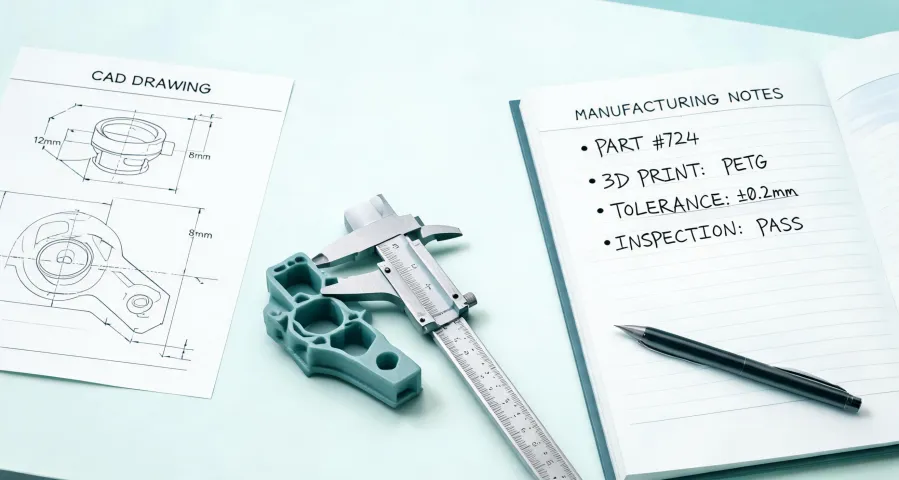
I'm an office administrator for a 40-person product development firm. When I took over purchasing in 2020, I inherited 8 vendors and no documented quoting process. I manage roughly $300,000 annually in orders across machining, injection molding, and 3D printing. I'm not a manufacturing engineer, so I can't speak to spindle speeds or optimal draft angles. What I can talk about is how much effort it takes to get a good part, how predictable the process is, and what can go wrong from an order-management perspective.
Where the Real Difference Shows: Quoting
This is a comparison between Fictiv manufacturing and the traditional RFQ process. I'm not here to say local machine shops are bad. Some of my best vendors are small shops. But the process of working with them is different from the digital-manufacturing model, and that difference matters more than a line-item price.
The comparison uses the same set of jobs each time: 50-100 CNC-machined aluminum parts, low-volume injection molding for an enclosure, and occasional 3D printed prototypes. I'll walk through quoting, capabilities, feedback, sustainability, and paperwork from a buyer's perspective.
In the traditional process, I'd email a step file and wait. Sometimes a thoughtful machinist would call with questions; sometimes the quote took four days. No one was being lazy—quoting is real work. But from my side, a four-day quote eats into a 10-week project timeline. I still kick myself for not asking suppliers for quoted lead time earlier. If I'd done that in 2020, I'd have saved a lot of schedule anxiety.
With Fictiv, I upload the CAD file to the Fictiv website and get an instant quote. The first time I did it, I want to say the quote came back in about 20 minutes, but don't quote me on that—it was fast enough that I remember being suspicious. The platform flags design-for-manufacturing issues before I even place an order. That's a clear win for standard parts.
But here's the nuance: if your drawing calls for a specialized process like Lincoln laser welding, the Fictiv website won't quote it. Fictiv's platform is built around CNC machining, injection molding, and 3D printing. For laser welding, you need a shop with the right equipment and a person who knows how to set it up. In that case, a traditional quote is the only option.
Quote conclusion: For standard parts, instant quoting makes the Fictiv website the better starting point. For specialty processes, you're back to human conversations.
Capabilities, CNC Basics, and the Limits of a Platform
For anyone who's ever wondered what does cnc milling mean, here's a quick primer: CNC milling is a subtractive process. A rotating cutting tool moves across a block of metal or plastic and removes material according to a digital program. It's different from 3D printing, which adds material layer by layer. Milling is good for tight tolerances, durable parts, and materials like aluminum, steel, and engineering plastics.
Traditional shops have something that a platform can't bottle: a machinist who can look at a part and say, 'you might have tolerance issues on this feature.' I've had a local shop catch a missing thread depth that would have ruined a prototype. That kind of experience is real.
Fictiv manufacturing gives me something else: breadth. I can get CNC milling, injection molding, and 3D printing from one login. I don't have to manage three separate vendors for one project. The network handles secondary operations and surface finishes, and I've received parts within tolerance without follow-up calls.
Capability conclusion: If you know what processes you need, the platform wins on breadth. If you need a highly unusual part that requires close collaboration or a specialty process like Lincoln laser welding, a traditional shop is the better fit.
Feedback That Saves You From Yourself
This is where the comparison gets counterintuitive. You'd think a digital platform would give generic feedback, while a human shop would give better feedback. In my experience, it's the reverse for standard parts.
Fictiv's automated DFM check caught an undercut that would have required a different tool. No, wait—it actually caught a wall-thickness issue in the injection molded enclosure that I hadn't considered. The feedback was specific and fast. For a buyer like me, that's gold because it means fewer revisions.
But for complex parts, a human voice is worth more than a screen. I'm not a design engineer, so I appreciate when a machinist says, 'we can make this, but we'd suggest changing the corner radius to 0.030 inches.' That's the kind of conversation you can't automate yet.
One thing I've learned: if color matters, make sure the molder can match your brand color. According to Pantone Color Matching System guidelines, the standard tolerance for brand-critical colors is Delta E < 2. I've seen a part look fine on a screen and the molded sample was off. Verify color standards before production, especially if you're using recycled materials.
Feedback conclusion: For standard geometry, Fictiv's automated feedback is faster and often more accurate than waiting for a shop to call back. For something unusual, talk to a human.
The Sustainable Injection Molding Question
Sustainable injection molding is a phrase I hear more often in procurement. Most buyers mean two things: using recycled or bio-based resins, and reducing waste in the manufacturing process. Both matter, but they're different.
In a conventional RFQ, sustainability is rarely quantified. You ask if they use recycled material, they say yes, and you move on. With a platform like Fictiv, low-volume production can reduce overproduction—you order exactly the quantity you need instead of committing to a huge mold-and-run minimum. That's a genuine sustainability win.
However, I have to be honest: the greenest option depends on the whole supply chain. A local shop using recycled aluminum and short trucking distances might beat an online platform's carbon footprint, especially if the platform ships cross-country. Sustainable injection molding is not a category where 'digital always wins.'
Because I'm not a sustainability auditor, I'll leave the carbon accounting to the experts. From a purchasing perspective, the best thing you can do is ask for specifics: recycled content percentage, mold cycle time, and annual energy usage.
Sustainability conclusion: Fictiv's low-volume model helps reduce overproduction, but if you need certified recycled resin or minimal shipping impact, get quotes from both and compare the details.
Paperwork, Invoices, and Hidden Procurement Costs
This is the dimension nobody talks about. The cheapest quote can cost you money in other ways. In 2022, a vendor gave me a great price on a small batch of parts, but they couldn't provide a proper invoice. Finance rejected the expense, and I ate $2,400 out of the department budget. Now I verify invoicing capability before placing any order.
Fictiv's platform gives itemized pricing and downloadable invoices. That saves our accounting team about six hours a month compared to chasing down purchase orders. For a 40-person company, that's meaningful.
Traditional shops are not all bad at paperwork, but the level of polish varies. I have one trusted shop that still emails PDFs, and we make it work. The hidden cost is the back-and-forth, not the part itself.
Paperwork conclusion: If your finance team values clean digital records, the Fictiv platform wins.
So, Fictiv or Traditional Manufacturing?
Use Fictiv if you're ordering standard CNC machined or injection molded parts, you have CAD files ready, and you want fast quotes and clean records. It's also a good option for prototype iterations where speed matters more than the social relationship.
Use a traditional shop if you need a specialty process like Lincoln laser welding, if the part requires a machinist's judgment, or if you want a local partner to stand next to you during development.
- Fictiv: standard parts, tight turnarounds, DFM feedback, digital ordering, low-volume production.
- Traditional shop: specialty processes, complex geometry, in-person collaboration, local supply chains.
This worked for us, but our situation is a small product development firm with predictable ordering patterns. If you're in medical devices, aerospace, or any regulated industry, the calculus might be different. I can only speak to my context. And in my context, the best answer isn't 'always Fictiv' or 'always traditional'—it's matching the process to the part.
