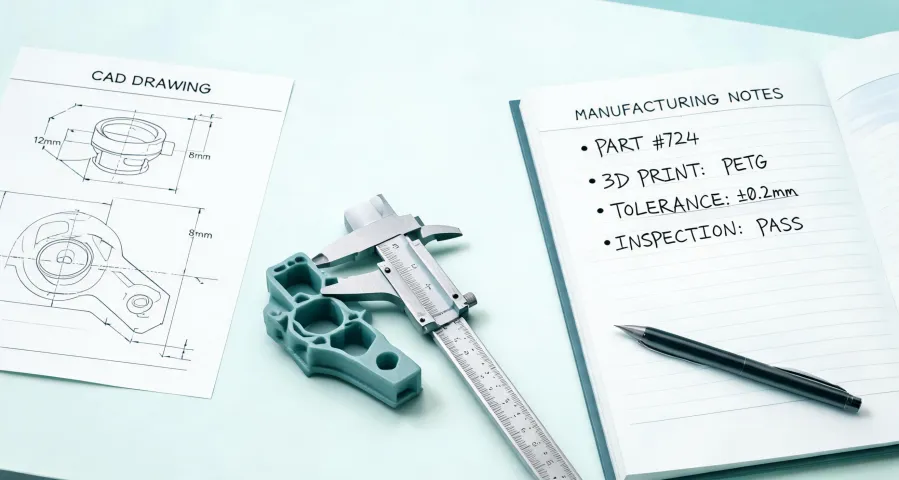
Here's a question I get asked a lot, whether I'm reviewing a supplier contract or debriefing after a project kickoff: Should we use a digital manufacturing platform, or stick with our local machine shop?
The short answer? It depends entirely on what you're making, how fast you need it, and—honestly—how much you trust your own specifications. I've spent the last few years on the quality side of manufacturing, reviewing parts that range from simple brackets to multi-axis CNC housings. And I've seen both approaches succeed, and fail, in pretty spectacular ways.
So instead of giving you one recommendation, I'll break this down into three common scenarios. Figure out which one sounds like your current project, and the path forward should be clearer.
Scenario A: You Need Standard Parts, Fast, and in Moderate Volumes
This is the sweet spot for a digital manufacturing platform like Fictiv's digital manufacturing platform. If your part can be defined by a clear 3D model, has standard tolerances (think ±0.005" for machining, or standard wall thickness for injection molding), and you need 50 to 5,000 units, the platform model wins almost every time.
Here's why, from my perspective: consistency. When I'm reviewing parts that come off a platform, the variability between units is usually lower than what I see from small local shops. That's not a knock on local shops—it's just that platforms standardize their processes in a way that a 10-person shop rarely can. They've automated the quoting, the DFM feedback, and often the inspection workflow. (I should add: this assumes your CAD file is clean. If your model has issues, no platform can fix that for free.)
I went back and forth on recommending a platform for our Q3 2024 production run—200 units of a machined aluminum enclosure. The local shop I trusted quoted $4,200. The platform quoted $3,650. The platform's price was lower, but I worried about communication. Ultimately, I chose the platform because the automated quoting meant I could iterate on the design three times without anyone losing patience. The parts arrived in 8 days (standard lead time was 10, so it was actually early). The finish was consistent across all 200 units. That's satisfying—especially after the stress of a tight timeline.
Key takeaway for Scenario A: If your part is well-specified, standard, and you value speed and consistency over deep engineering hand-holding, a platform like Fictiv is likely your best bet. This applies to fictiv machining (CNC) and simple injection molding runs.
Scenario B: You're Prototyping with Industrial 3D Printing—and You Need to Pick the Right Tech
This is where things get interesting. If you're asking about the best 3d printers for industrial applications 2025, you're probably not thinking of buying a printer—you're thinking of using a service. And the question shifts from which printer? to which print technology and which partner?
I'll be honest: I was skeptical of 3D printing for functional parts for a long time. (I came up through CNC and injection molding, where the part is either right or it's scrap.) But in the last two years, I've seen industrial 3D printing—particularly SLS and MJF—produce parts that are genuinely production-viable.
For this scenario, the choice isn't really between a platform and a local shop. It's between a service that offers a wide range of technologies (like Fictiv's 3D printing options) versus a specialist bureau. Here's my rule of thumb:
- Use a platform if: you need quick quotes, multiple technology options, and you're willing to do your own DFM research. Platforms are great for rapid iteration.
- Use a specialist if: you need a specific exotic material (like PEEK or Ultem), or you're doing something that requires extensive engineering review.
And to answer a related question I see online: are 3d printers robots? Technically, they're automated machines, not robots in the collaborative sense. But the important thing is that a service using them is not a robot—it's a team of people who program, maintain, and inspect those printers. Don't assume that using a digital platform means you're dealing with software alone. You're still dealing with humans (fortunately).
Key takeaway for Scenario B: For industrial 3D printing in 2025, a platform is excellent for prototyping and short runs. For specialized materials or mission-critical applications, a specialist service may be worth the premium.
Scenario C: You Need Local Support—Think Laser Cutting in a Specific Geography
Now, this is a scenario that a pure digital platform can't solve well: when you need laser cutting chula vista or any hyper-local service. Why? Because laser cutting—especially for larger sheets or structural components—often depends on local material stock, local transport, and sometimes on-site adjustment. If you're near Chula Vista and you need laser-cut steel brackets for a local construction project, the fastest and most cost-effective option is almost certainly a local sheet metal fabricator.
I've seen projects fail because someone tried to use a national platform for a job that really needed local logistics. The platform quoted a great price, but the shipping cost and lead time ate the savings. (To be fair, platforms are improving their local partner networks. But in early 2025, the gap still exists for some regions and materials.)
So if your project requires fast turnaround on laser cutting, and you're working with materials like mild steel or stainless steel in sheet form, look for a local shop first. The platform can't compete on that one.
Key takeaway for Scenario C: For local services like laser cutting, geography matters more than platform features. Save the digital platform for parts that can be shipped without rush.
How to Know Which Scenario You're In
Here's a simple litmus test I use when advising my team:
- Is your part defined by a complete, unambiguous 3D model, with tolerances and finish specified? Yes → You're likely in Scenario A or B. No → You need more engineering review before you order anything.
- Do you need the part in less than 5 business days, and are you willing to pay a premium for speed? Yes → Consider a platform's rush service (they're good at this). No → You can evaluate more options.
- Is your delivery address within 50 miles of where the part will be made? Yes → Consider local, especially for laser cutting or heavy parts. No → Platform wins on logistics.
There's no single right answer. I've been in situations where the platform saved me. I've been in situations where only a local shop could get me out of a tight spot. The key is knowing which box your project fits into before you start getting quotes.