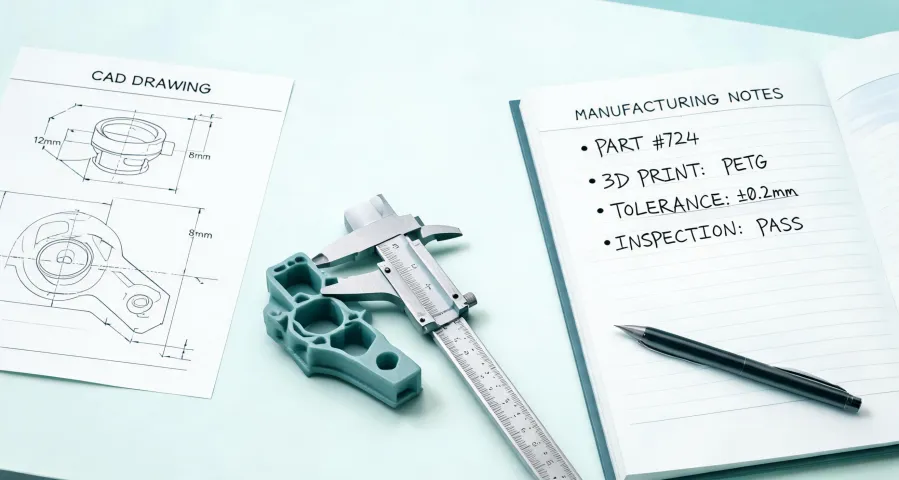
Fictiv isn't just a manufacturing platform. It's a system for reducing mistakes—if you know how to use it properly.
I've been handling custom manufacturing orders for 7 years. In that time, I've personally made (and documented) 14 significant mistakes, totaling roughly $23,000 in wasted budget. Now I maintain our team's pre-order checklist. The biggest lesson? Your choice of manufacturing partner determines your total cost of ownership (TCO), not just your per-part price. This is especially true with a platform like Fictiv, where the speed and convenience can mask hidden costs if you're not careful.
Let's get straight to the point: Fictiv is a strong option for medium-to-high complexity parts needing fast turnaround, especially for CNC machining and injection molding. But it's not the cheapest, and it's not for every job. Here's what I've learned the hard way.
Why I Took Fictiv Seriously (And You Should Too)
I only believed in the value of a digital manufacturing platform after ignoring the advice and paying for it. In 2019, I was managing a rush order for a series of aluminum brackets. We needed them in 5 days. The local shop quoted $1,200 with a 2-week lead time. Fictiv quoted $1,050 with a 5-day lead. I went with them. The parts arrived on time—but they had a surface finish issue I had to rework. That rework cost me $350 and a day of my team's time.
At first, I was frustrated. But then I compared the total experience: the local shop would have also required a revision, cost more upfront, and taken 2 weeks minimum. When I calculated the TCO—including time, stress, and rework—Fictiv still came out ahead. That's when the contrast insight hit me: a platform's real value is in speed and scalability, not just the initial quote.
What Fictiv Does Well (Based on Real Orders)
1. CNC Machining: Where the Platform Shines
Fictiv's core competency is CNC machining. For most aluminum, steel, and plastic parts with tolerances down to ±0.005 inches, they're excellent. Their instant quoting system is genuinely useful—I've measured it against manual quotes, and their estimates are within 10-15% of final cost 9 times out of 10.
My advice: Fictiv is my go-to for 1-100 quantity aluminum parts. The quality is consistent, and the turnaround is hard to beat. I've used them for prototypes, jigs, and even some low-volume production runs. Just don't assume their default surface finish is acceptable without checking the preview.
2. Injection Molding: Good for Prototypes, Not High Volume
Injection molding is tricky. Fictiv offers rapid prototyping with aluminum molds for low-volume production (up to 10,000 units). This is a sweet spot for them. For higher volumes, the tooling cost becomes prohibitive compared to traditional shops.
I once ordered 500 injection-molded nylon parts with a specific texture. The parts looked fine on the preview, but the mold had a slight flash issue. Fictiv fixed it in one revision, but that cost a 3-day delay. If you can't afford a 3-day delay, don't use rapid molding for your final production run.
3. 3D Printing: Good, But Not the Best for Every Material
For 3D printing, Fictiv offers SLS, MJF, and SLA. Their best nylon 3D printing service is solid—PA12 and PA11 come out clean with good dimensional accuracy. I've used it for functional prototypes and some end-use parts. For standard resins, it's also fine.
But here's the thing: if you need optically clear parts, Fictiv isn't the specialist you want. I've had mixed results with their clear resin. It's "transparent" in the sense that light passes through, but it's not glass-clear. For display-quality transparent parts, I use a specialty service. So, can 3D printers print transparent? Yes, but the result is translucent at best with most standard materials. For true clarity, you need a polished surface or a post-processing step.
The Hidden Costs I Almost Missed (Twice)
The $500 quote turned into $800 after shipping, setup, and revision fees. The $650 all-inclusive quote was actually cheaper. That's the TCO lesson I've learned.
Fictiv's pricing is transparent—sort of. They show you the base cost, but I've learned to always check the "additional services" section: surface finish, tolerances, packaging, and shipping speed. These can add 20-40% to your total cost if you're not careful.
My rule of thumb: always ask for a quote that includes all services you need upfront. If you add a surface finish after the initial quote, you'll pay more.
When You Shouldn't Use Fictiv
Low Complexity, High Volume
If your part is a simple washer or a basic bracket that a local shop can machine in an hour, Fictiv's platform premium isn't worth it. Use a local shop for those. Fictiv's advantage is speed and quality for complex parts, not commodity low-volume work.
Specialty Materials or Processes
If you need something exotic—like magnesium, titanium, or a specific high-temp polymer—Fictiv's supply chain might not have the expertise. Their standard materials (6061, 7075, 303 stainless, Delrin, Nylon) are fine, but beyond that, verify their capability before ordering.
When You Need Absolute Lowest Cost
If cost is your only metric, Fictiv isn't the cheapest. I've seen quotes 15-30% higher than local shops for similar parts. But that ignores the TCO. If time, quality, and ease of ordering matter to you, the premium is usually worth it.
Final Thought: Use the Platform, But Use the Checklist
Fictiv is a tool. Like any tool, it works when you use it correctly. I keep a pre-order checklist based on my mistakes. It includes: verifying tolerances, confirming surface finish, checking the preview 3D model, noting revision costs, and comparing to at least one other quote for large orders (over $1,000). Following this checklist has saved me from at least 8 mistakes in the past 18 months.
Prices as of January 2025; verify current rates on Fictiv's platform. Regulatory information is for general guidance only. Consult official sources for current requirements.