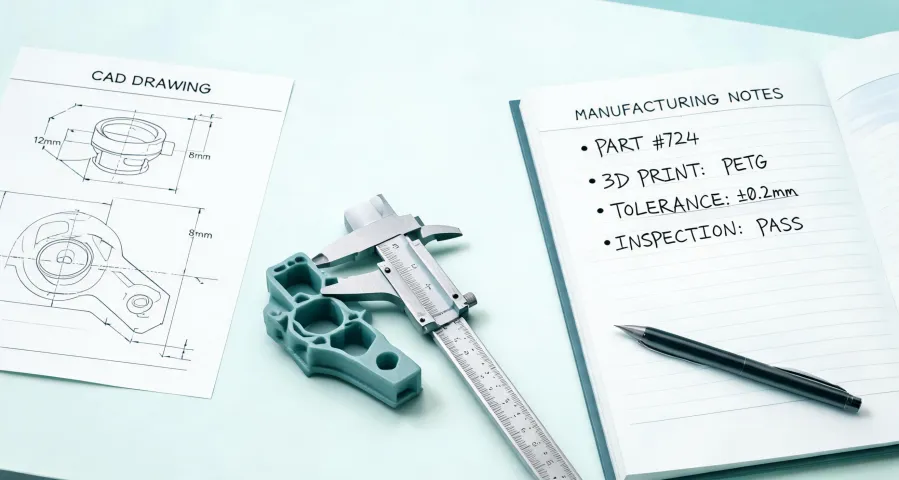
In 2021, I watched a batch of machined aluminum parts fail incoming inspection. The thread gage did not seat. The surface finish looked more like a rough mill pass than the bead-blasted finish on the drawing. The shop owner kept saying the drawing says what it says. He was not entirely wrong.
Two weeks earlier, I had uploaded that same part to the Fictiv website for a quote. The quote came with a design-for-manufacturability note that flagged a missing surface finish callout and a risky tolerance on one hole. I saw the higher price, compared it to a local shop's informal email estimate, and decided Fictiv was too expensive. I placed the order with the local shop. Then I paid roughly $3,200 to redo parts, expedite replacements, and explain the delay to my manager.
After that failure, I started documenting every sourcing mistake I made. That checklist has caught 47 potential specification problems before they became purchase orders. This article is the story behind the first rule on that list.
The Surface Problem: It Looked Too Expensive
When I first compared quotes, my brain reduced the decision to the number at the bottom. The local shop's number was lower, and that felt like math. What I did not realize was that the local shop had not actually analyzed the part. It had seen an aluminum housing, estimated a few hours, and sent me an email.
To be fair, many skilled machinists quote that way and still deliver great parts. On this part, though, nobody caught a real ambiguity. Fictiv caught it before production. I ignored the feedback because it showed up inside a more expensive quote.
The real problem was not the price difference. It was my definition of a quote.
The Real Problem: A Quote Is a Risk Proposal
A manufacturing quote is not material plus machine time. It is a shop's estimate of how much ambiguity your drawing contains and how much support they will need from you. If they miss an unclear tolerance and only discover it after setup, that discovery has a cost. If you call out a sharp internal corner that needs a smaller tool, that costs money. If you leave out a finish, the shop has to guess what standard means.
That is why two quotes for the same part can look so different. One shop may quote the happy path. Another may quote the realistic path. You will not know which path they priced until parts arrive or the phone rings.
Search for Fictiv company overview manufacturing and the standard summary will mention a digital manufacturing platform for CNC machining, injection molding, and 3D printing. That description is correct, but it misses the part that saved me. The platform gives manufacturability feedback before you place an order. On the Fictiv website, I upload a model and see notes about tight radii, unspecified finishes, and questionable tolerances.
A design-for-manufacturability note is not a slight against your design. It is a second set of eyes. I only learned that after ignoring it and eating the cost. Now the first rule on my checklist is simple: read all quote feedback before comparing unit price.
The Part of the Drawing I Didn't Finish
My actual part had a small problem: I called out surface finish on the two big visible faces, but not around the counterbores and threaded holes. In my head, a general note covered it. It did not. The local shop chose a standard machining finish there, and that texture interfered with our fit. Fictiv's note asked whether the finish needed to apply to all faces. I thought that was overkill at the time. It was exactly the right question.
The cheaper supplier did not call to discuss that ambiguity. Nobody does. They chose the easiest interpretation, cut the parts, and sent an invoice. In fairness, that is not always malicious; they simply do not know what you imagined. If the drawing leaves room for two readings, one of them will be the wrong one.
The Process Problem I Kept Ignoring
Even when I saw that DFM note, I did not fully value it because I was thinking about geometry, not process. The same aluminum alloy can produce very different parts depending on toolpath, heat treatment, surface treatment, and inspection method.
Researchers at the MIT additive manufacturing lab have shown that build orientation, layer height, and thermal history affect the strength of printed parts. If a part's mechanical properties can change with build direction, the process behind a machined or molded part obviously matters too. A drawing cannot capture all of that. A good quoting process should at least ask about it.
The Wrong Source Problem
This is also why I now pay attention to the questions people actually ask before choosing a process. Someone will search for accurl press brake price because they need sheet metal parts. Unless they are buying a press brake for their own factory, that number is not useful. A machine price is capital equipment cost; a sheet metal quote is a manufacturing service.
Outside manufacturing, the same mismatch shows up with queries like how long after co2 laser can you get botox. That is a medical question. The right person to answer it is a clinician, not a machine shop. It sounds unrelated, but the lesson is the same: the wrong source produces confident, irrelevant answers.
How I Compare Manufacturing Quotes Now
I don't use Fictiv for every order. I still work with specialized shops for certain jobs. But my process changed in three ways.
First, I start with a DFM check. Even if I don't buy from Fictiv, uploading to the Fictiv website helps me see questions I forgot to answer. Second, I send the same drawing to suppliers and ask them to confirm ambiguous callouts in writing. Third, I compare how many questions each quote generated. A quote with no questions is no longer a gift; it is a warning.
Don't hold me to exact lead times or current pricing, because Fictiv's capabilities have expanded since 2021 and the manufacturing market changes quickly. Check the site before budgeting around specific turnaround expectations.
The Hardest Lesson
The mistake was not paying more for Fictiv. The mistake was treating every quote as the same product. A cheaper quote that hides risk is not cheaper. A quote that asks hard questions before cutting metal is doing you a favor.
There is something satisfying about watching a DFM note catch your own design error before a machine ever touches the material. It took one expensive order to learn that.