“Let’s just make it.”
That was Seth’s solution when we realized we didn’t have a tool holder for the compound-angle job we’d just accepted. The customer wanted 200 stainless fittings, the shipping date was fixed, and none of our standard holders positioned the insert correctly. Seth is our lead machinist and one of the best people I’ve worked with in four years of doing quality reviews, so when he said we could cut this in-house, I believed him. That was my first mistake.
That same Monday, I spent forty minutes on the county assessor’s website trying to download the PDF of our VMC property tax bill. The VMC itself is a workhorse. It doesn’t care about paperwork. But owning one means you eventually become the person who saves asset schedules, forwards tax documents to accounting, and learns the county portal’s login rules by heart. It’s not the machine that wears you down. It’s the small stuff that piles up around it.
The tool holder felt like small stuff, too. A block of steel, three or four machined faces, a slot, a clamp. What could go wrong?
The lathe tool holder DIY looked like a no-brainer
I could have ordered the holder from an outside shop. We even asked around. The quotes ranged from roughly $350 to $700, with lead times starting at eight business days. That was the problem. Waiting eight days would push our fitting order dangerously close to the deadline, and if the supplier slipped, we’d be the ones apologizing to the customer.
Doing it ourselves had a different cost. Seth estimated four hours of work. Add a $60 block of 4140 steel from our stock, maybe a fresh endmill, and we’d be around $360 total. We would also have the holder the next day instead of next week. At that moment, it felt like a no-brainer. It wasn’t.
Here’s the part I keep kicking myself about: I had already seen this pattern. In Q1 2024, we rejected a batch of parts because the vendor’s finish wasn’t consistent with their sample. They claimed it was within industry standard. We rejected it anyway, and the redo cost them two weeks. I knew that “fast” and “good” are not the same thing. But I let the deadline pressure override what I should have caught earlier.
When the DIY tool holder went sideways
Seth started cutting on Tuesday morning. By Tuesday afternoon, the first version looked right. Then he mounted it on the lathe, swept an indicator across the insert, and found the tip sat about eighteen thousandths below center. On a lathe, tip height matters. Eighteen thousandths is enough to cause chatter, and chatter is enough to ruin a surface finish on stainless.
The test part came off rough. I rejected it. Not because Seth had done sloppy work—he hadn’t—but because a rough finish is a quality defect, and I was the one who had to sign off on it. We agreed to make another one.
Wednesday was worse. The second version had the tip height correct, but the clamp slot was misaligned. While Seth was testing it on a scrap blank, a carbide insert shattered. Nobody was hurt, but the sound was enough to make the whole shop look up. That was the moment I realized we were no longer solving a tooling problem. We were feeding a sunk-cost trap.
By Wednesday afternoon, we had burned eleven hours of Seth’s time across two attempts. At our blended shop rate of $85 per hour, that was already over $900 in labor, before counting the steel and the ruined carbide insert. The failed DIY had cost more than any outside quote we’d received. And we still didn’t have a tool holder that worked.
A fictiv manufacturing company overview, from someone picky about quality
I called an engineer I know from a previous project and asked who they used for fast-turnaround CNC work. He said Fictiv. I had heard the name before, but I hadn’t really explored it.
For anyone searching for a “fictiv manufacturing company overview,” here’s the short version: Fictiv is not a single factory. It’s a digital manufacturing platform that connects engineering teams with a network of vetted production partners. You upload a CAD file, pick a process—CNC machining, injection molding, or 3D printing—choose a material and finish, and get a quote with a lead time. The platform handles manufacturing review, quality documentation, and shipping. That might sound like a brochure, but I care less about marketing and more about the fact that I could see a delivery date before I clicked “place order.”
The quote for our tool holder came back at $467, plus shipping, with a four-to-five-business-day lead time. It wasn’t the cheapest quote we could have found. It was the one that got us closest to the deadline without risking the whole order. I stared at the confirmation button and did the math again: if we delayed the fitting order by a week, the customer’s line would stop. That was a bigger cost than any tool holder in the building.
I placed the order.
Then I immediately second-guessed myself. Did I pick the right material? Should I have chosen a different surface finish? Would the partner shop catch the same geometry problem we’d missed? I didn’t fully relax until I received the shipping confirmation two days later.
The part that arrived, and the 3D printed side quest
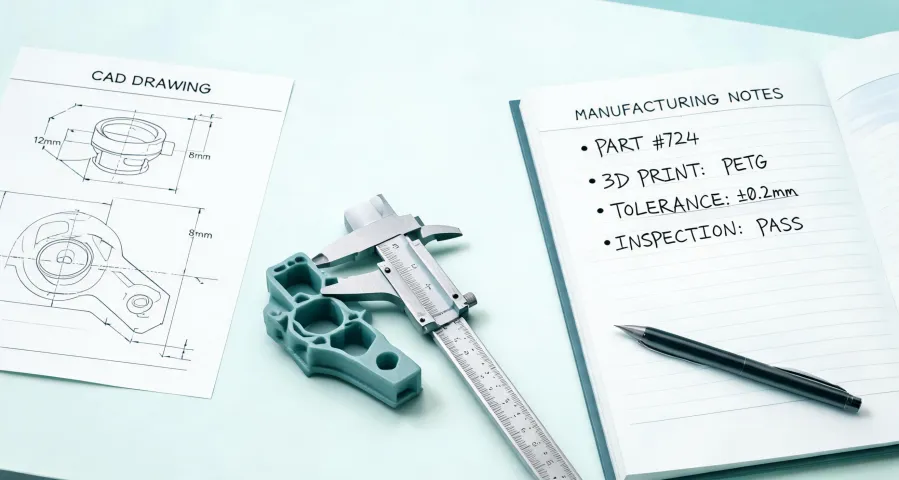
The package arrived on March 21, 2024. I opened it at the inspection bench, checked the dimensions against the drawing, and mounted the holder on the lathe. The insert sat where it was supposed to sit. Seth ran a test piece, and the finish was clean enough that I stamped the first article without hesitation.
There’s something satisfying about a part arriving exactly to spec after you’ve spent two days failing to make it yourself. It’s not just relief. It’s the feeling of a process working the way it’s supposed to work.
We also included a 3D printed prototype clip in the same order. Earlier that week, I had typed “who sells 3D printers in store” into a search engine because we needed a plastic clip for a customer evaluation and I didn’t want to wait for a typical online print service. The search results were not the problem. The problem was that buying a $500 printer to make one $50 prototype didn’t make sense. Fictiv offered 3D printing in the same dashboard, so we added the clip to the order. It arrived in the same shipment. We didn’t need to own a printer. We needed a part.
That lesson stuck with me more than the tool holder did.
What I would do differently next time
First, I would separate the make-versus-buy decision from the schedule pressure. When you are under a deadline, everything looks urgent, and it’s tempting to believe that working faster in-house is safer than trusting an outside supplier. In our case, the opposite was true. The outside supplier had a process designed for fast, documented, repeatable results. We had a machinist who was also trying to keep our other customer orders running.
Second, I would add a tougher question to our internal checklist: is this part actually our core work? A custom tool holder is not our product. The 200 stainless fittings were our product. Every hour we spent building a holder was an hour we weren’t spending on the job that paid the bills.
Third, I would stop treating the price of certainty as an expense. The $467 tool holder felt expensive compared to our original $360 estimate. But the DIY attempt already cost us more than that in labor and materials, and it still didn’t work. The real cost of the DIY path was the schedule risk. If we had slipped the ship date by a week, the conversation with our customer would have been far worse than any invoice.
Does that mean you should never make your own tooling? No. Sometimes in-house is the right call, especially if you have the capacity and the tolerance is forgiving. But if the part is blocking a customer commitment, don’t gamble the deadline to save a few hundred dollars. Pay for the date you can rely on.
As for the VMC property tax bill? It still shows up like clockwork. The PDF still lives on the county portal. That paperwork isn’t going anywhere. But at least now, when we have a tooling gap, we know the difference between making something because it’s strategic and making something because we’re stubborn.