-
Start With a Specification, Not a Company Name
-
What I Like About the Fictiv Manufacturing Platform
-
When Local CNC Turning Companies in Bedford Still Make Sense
-
Best Laser for Cutting: Material Determines the Machine
-
Which 3d Printers Have the Best Reviews? That's the Wrong Question
-
What I Would Not Use Fictiv For
Here's the shortest version of what I've learned after four years of inspecting custom-manufactured parts: The most reliable supplier is not the one with the best review score or the quickest quote. It's the one that makes your assumptions visible before money changes hands. People search for 'Fictiv CNC' or 'cnc turning companies Bedford' when the real question underneath is, 'Who can make this part correctly without me having to police every step?' That is a quality problem, not a logistics problem.
I review roughly 200 unique part numbers a year. In 2024, I rejected a little over 12% of first deliveries for specification issues. The defects were rarely because the machine couldn't hold the tolerance. They happened because someone interpreted a missing note, a quiet dimension, or an 'industry standard' differently than the engineer intended. That is where a manufacturing partner proves itself or fails you.
Start With a Specification, Not a Company Name
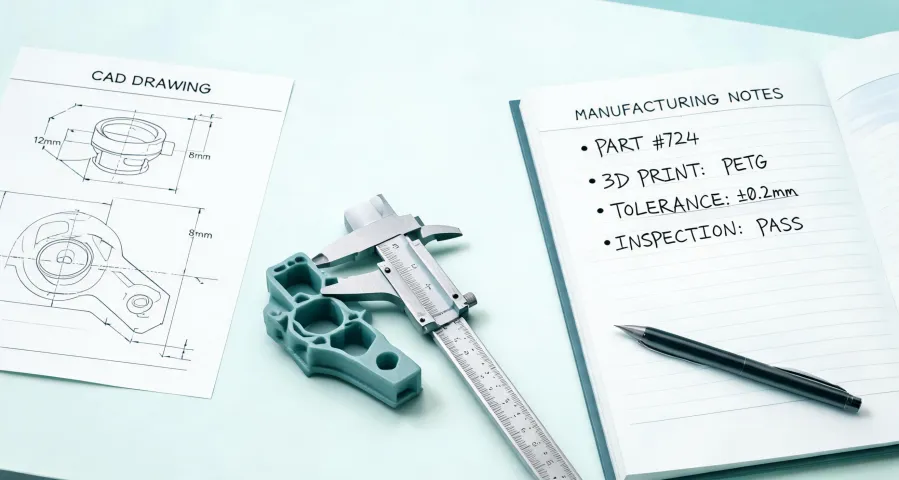
The first thing I check is not a brand. It's the drawing. Does the model have clearly defined critical surfaces, tolerances, and finish requirements? If a quote request has no notes, I already know the failure risk is high.
Fictiv's manufacturing platform pushes in that direction. You upload a model, get digital DFM feedback, and receive a quote before any material gets cut. For me, this is not just convenience. It moves quality checks to the front of the process, where they belong. I once quoted a machined bracket with a blind threaded hole placed close to an internal wall. The DFM check flagged the risk and suggested a slightly different thread location. It was a five-minute adjustment in the CAD model. Without that flag, a local shop could have made the part as drawn, and the thread might have blown out during tapping. Those are the failures that cost weeks.
When I hear someone ask if Fictiv CNC is 'good enough,' I usually answer that Fictiv takes away some of the noise that creates defects: unclear order status, missed DFM comments, lost revision history. That doesn't mean every Fictiv part is perfect. No vendor is perfect. But quality issues become easier to find and easier to correct when a platform records decisions.
What I Like About the Fictiv Manufacturing Platform
Here's an honest summary: If you need one supplier for CNC machining, injection molding, and 3D printing, the Fictiv manufacturing platform offers a practical way to run development and production. It is good for engineering teams because it creates a repeatable workflow. It also helps when you are evaluating multiple processes for the same part, because you can compare CNC versus 3D printing at an early stage.
The part of Fictiv I care about as a quality inspector is the ability to keep track of revisions and supplier feedback. There is no such thing as a quality department reviewing only final parts. By the time you are measuring the final part, it is already too late. You need upstream conversations about geometry and process. Fictiv gives you those conversations in a structured place.
When Local CNC Turning Companies in Bedford Still Make Sense
I know not every shop needs to become a digital platform. Local turning shops have real advantages. If you type 'cnc turning companies Bedford' because you need a turned part this week and you are near that area, you might not need a full platform. For simple shafts, bushings, and fittings, a skilled nearby shop often makes sense. The advantage is access: you can discuss material, tooling, and tolerances with someone who is actually standing near a lathe.
But do not assume local is faster. The 'local is always faster' thinking comes from an era before production scheduling software and remote manufacturing coordination. I have seen a local CNC shop let a simple turning job sit for three days because nobody updated the job board. I have also seen online manufacturing platforms deliver faster because the order status is visible. There are good local shops and bad local shops; the same is true online. Choose based on the person or system that will actually manage the work order, not based on geography alone.
Best Laser for Cutting: Material Determines the Machine
Another search term I see is 'best laser for cutting.' There is no single answer because cutting applications are not the same. A fiber laser cuts sheet metal quickly and precisely, while a CO2 laser is often better for wood and acrylic. Power and wattage do not fix the wrong machine-material match.
For production, decide two things first: material and thickness. Once those are defined, 'best' becomes a smaller list. The same principle applies to a manufacturing platform. You don't ask if it is good. You ask if it is good for your part's geometry, volume, material, and required quality evidence.
Which 3d Printers Have the Best Reviews? That's the Wrong Question
Search data is full of 'which 3d printers have the best reviews?' I understand the instinct. But as someone who qualifies parts for a living, I have learned that review scores do not measure repeatability. A 4.8-star printer might be excellent in one person's office and still vary too much overnight when you switch materials. Reviews also say little about dimensional drift, chamber consistency, or material certification.
Per FTC guidelines (ftc.gov), endorsements should be truthful and substantiated. That is useful for spotting fake reviews, but even honest reviews do not guarantee that a printer fits your process. If I am making a bracket that must fit over a shaft, I do not choose a printer by reviews. I choose a process and material profile that has engineering data behind it. For prototype parts where fit is not critical, review scores can be a rough starting point. For production, treat 'best reviews' as research, not as evidence.
What I Would Not Use Fictiv For
Honest advice: if your part is still a half-developed idea, if you are working from a paper sketch, or if you need an engineer to reverse engineer a broken sample, a local design-and-machining shop is a better partner than an online manufacturing platform. The Fictiv manufacturing platform assumes a reasonably complete digital definition. It will help you improve the design, but it won't replace the person in the room who asks, 'What do you actually want this thing to do?'
I also would not send a one-off simple part to a platform if a local turning shop can hand you the finished part on the same day. The total cost includes time, trust, and the judgment that happens when someone can see your part in person.
So here's my rule: Use Fictiv when you need scalable capacity, multiple processes, clear order tracking, and digital DFM feedback. Use a local CNC turning company when the value is in personal judgment and immediate proximity. And when you are tempted to search for 'best laser for cutting' or 'which 3d printers have the best reviews?', stop looking for a hero product and start defining the problem. The best review won't save you from a vague tolerance. A good quality system might.