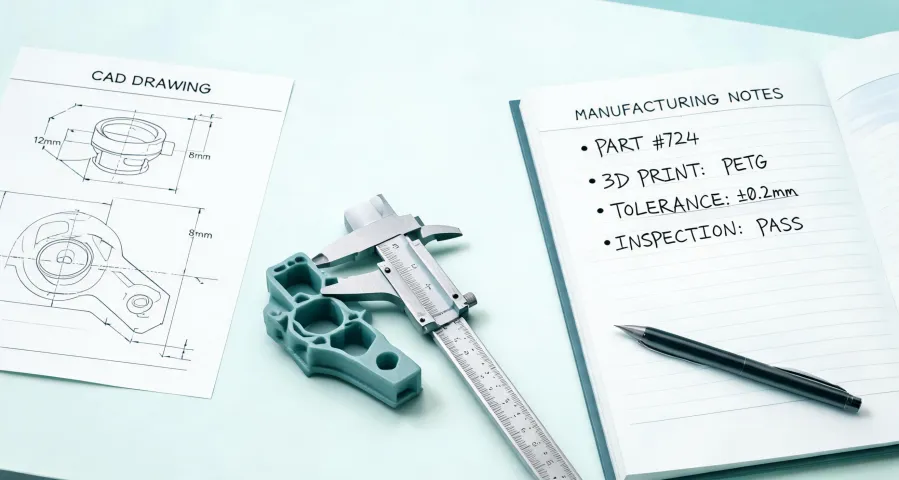
Back in March 2023, I was sitting in our tiny conference room with a purchase order I shouldn't have written. I'm the office administrator for a 42-person company that designs and sells industrial sensors. I manage roughly $220,000 a year in orders for prototype parts, custom enclosures, and the occasional oddball machine component. I report to both operations and finance. That means when a part is late or an invoice is rejected, I'm the one who hears about it.
It took me about two years and 60 orders to understand what I'm about to tell you: the best quote is rarely the lowest one, and the best vendor is rarely the one that says 'yes, we can do that' to everything.
I Took the Low Quote, Because I Assumed Cheaper Meant Better
In March 2023, we needed 200 CNC machined aluminum housings for a new sensor model. The drawing didn't look complicated to me—some holes, a few slots, a brushed finish. My predecessor used to buy from a local shop, and the owner quoted $4,480. That looked good. At the same time, I submitted the same drawing to Fictiv's instant quote portal, just to compare. Fictiv CNC machining came back at $5,020 with a seven-day lead time. The local shop said ten days, but 'probably sooner.'
Looking back, I should have asked for an itemized quote. The owner said 'the price is the price' and I let it go. That should have been my first red flag.
I assumed the local shop was faster and cheaper. 'Local is always faster,' I told myself. That was my initial misjudgment. I didn't think about setup fees, inspection reports, or what would happen if the owner didn't answer the phone.
What the Local Quote Didn't Show
I didn't verify line items. I assumed 'same specifications' meant identical results across vendors. It didn't. A week after we placed the order, the shop called and said there was a $980 setup and deburring charge that wasn't in the original quote. Then the parts arrived late—I want to say 12 days late, but don't quote me on that. It might have been 11. Either way, we missed our launch window.
What hurt more was the invoice. Finance rejected it because there was no PO number and no line-item breakdown. The owner sent a handwritten receipt. Finance said no. Our accounting team spent another six hours redoing the report. The 'cheaper' local order ended up costing about $6,400, and that doesn't include the time I spent explaining myself to my operations manager.
I made the same mistake a year earlier with a packaging supplier. The price was 15% lower, but they couldn't provide proper invoicing. We lost $2,400 in rejected expenses. I should have known better.
The parts that did arrive weren't great either. Fourteen were rejected by our quality person because of burrs in the tapped holes. They went back for rework. The launch delay was because of the rework, not just the late arrival.
The Search That Ended My Confidence in Guessing
Fast-forward to September 2024. A production engineer named Dan sent me a message: 'Can you get a quote for a Wotan CNC horizont mill service visit?' I stared at the screen. I had no idea what a Wotan was. I searched 'wotan cnc horizont mill' and got forum threads about spindle rebuilds, German castings, and people arguing about oil viscosity.
Then Dan followed up with a second question: 'Which milling cutter for high-feed finishing?'
That's not my world. I don't know carbide grades or chip thinning. I know purchase order numbers, vendor certifications, and how to get an invoice paid. Before Fictiv, a request like this meant three days of email ping-pong. I would dig through our shared Gmail account and find a folder labeled 'vmc gmail'—a catch-all for vertical machining center quotes from a former assistant—and still not have an answer.
In that old workflow, the request would have turned into a two-week project involving three suppliers, one RFQ spreadsheet, and a lot of voicemail. I kept thinking there had to be a better way. So I did the only useful thing I knew: I sent the part file to Fictiv and asked for their recommendations. Their response surprised me.
What Fictiv Did Differently
Fictiv didn't say 'sure, we can make it.' Their DFM feedback said: 'This geometry is easier on your cutting tools if you remove the sharp internal corner. If you plan to injection mold this later, add a draft angle here.' They also told me what they wouldn't do: they wouldn't advise on an old Wotan CNC horizontal mill or choose a high-feed finishing cutter for our in-house machines. That's not what they sell.
They answered in about a day, not a week. That speed matters when your engineer is waiting on a DFM note before he can finalize the model.
Honestly, that honesty felt weird at first. Usually suppliers try to make their capabilities sound infinite. But the vendor who says 'this isn't our strength—here's who does it better' is the one you trust for everything else. At least, that's been my experience over the last two years.
Then a Mold Quote That Made Sense
A few months later, we needed 5,000 injection molded enclosures. I went straight to the Fictiv injection molding quote process instead of calling a mold maker. The unit price was about 4% higher than an overseas quote. But the overseas price didn't include air freight, customs handling, or the eight-week lead time. Fictiv quoted 15 days for production plus domestic shipping. That comparison made the decision easy.
More importantly, their engineering team caught a mistake in our material callout. I don't remember whether it was ABS vs. PC/ABS—I might be misremembering the exact resin—but it would have cost us a few thousand dollars to redo a mold. That single comment paid for my skepticism.
Production went smoothly. The first article matched what we approved, and the invoice arrived with a clean PO number. I didn't have to chase anyone.
For the record, I re-ran the original 200-piece bracket quote on Fictiv's public instant-quote page on January 8, 2025. It came back at $5,118, with setup, material, and a 10-day lead time listed separately. I'm not saying online pricing is always lower. I'm saying the number was predictable. Verify current rates on the site because prices move, but the process felt more trustworthy.
The 'Local Is Faster' Myth
The belief that 'local is always faster' comes from an era before digital logistics. It was true 20 years ago when you had to fax a drawing and wait for a courier. Today, a well-organized online platform can beat a disorganized local shop on both price and lead time. I'm not saying every local shop is bad. The shop I used was fine for simple parts; it just couldn't handle the complexity and traceability we needed.
In our 2024 vendor consolidation project, I cut the number of prototyping vendors from eight to three. Fictiv became one of them. We still use a local shop for same-day emergencies, but those are rare. What I need is a vendor that gives clear quotes, delivers on time, and sends an invoice finance won't reject. Switching to online ordering also saved our accounting team about six hours a month in order matching.
What I Learned About Expertise
If you talk to any good engineer, they'll tell you the more you know, the more you realize what you don't know. That's why I trust a supplier who states a boundary. When Fictiv's team said 'we don't do that, and here's a better way for the part you actually need,' they became more credible, not less.
In custom manufacturing, 'we can do everything' is usually a warning sign. A specialist who knows their limits is more useful than a generalist who overpromises. That applies to people too. I'm not a manufacturing expert. I'm a buyer. But after two years of managing these relationships, I now know enough to ask the right questions.
And I know one more thing: the lowest number on a quote is not the cost of the part. It's just the beginning.