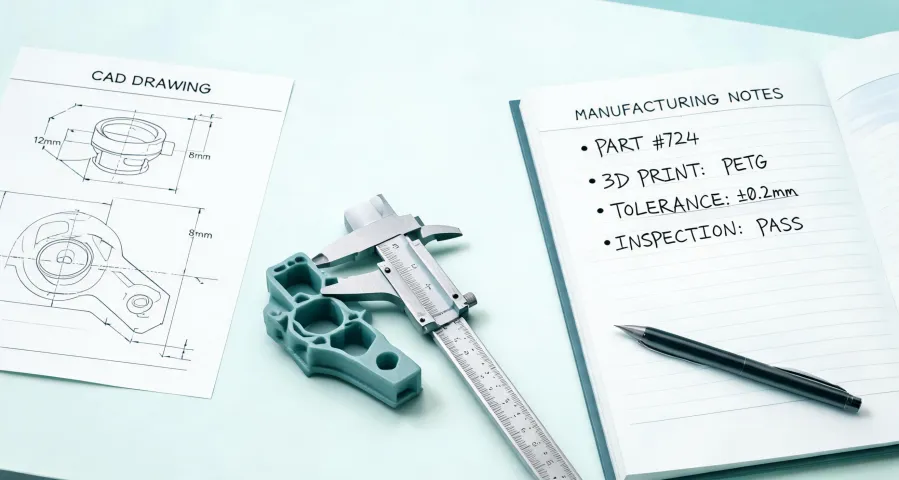
Before You Click Place Order
If you've ever received a quote and wondered whether the price reflects the actual part, this checklist is for you. It's for engineering teams, product designers, and procurement managers who are using a digital manufacturing platform and need to approve a quote without getting burned.
I'm a quality manager. I review every part before it reaches customers—roughly 200 unique parts a year go through my desk. In 2024, I rejected about 9% of first deliveries because the vendor and the drawing disagreed on what mattered. When I implemented a simple verification protocol in 2022, the rejection rate dropped by a third. This is that protocol.
If you searched for 'reamer endodontics' and landed here, be aware this is not a dental article. In machining, a reamer is a hole-finishing tool. In endodontics, it's a root canal instrument. Different words, different quality rules. Same thing with 'ball mill cnc': what people usually mean is a ball-nose end mill in a CNC machine, not a machine that grinds rocks.
Here are six checks I run before approving any manufacturing quote.
The Six Checks
1. Start with the drawing, not the price
The first thing I do is open the 2D drawing and read the title block. Not the CAD model, not the quote, not the Fictiv website. The title block tells you material, tolerance, finish, and revision. If you don't have a drawing, you're not ready to approve a quote.
What I mean is: if the part only exists as a STEP file, the machinist has to make assumptions about sharp edges, break edges, surface finish, and hole tolerances. Those assumptions will be wrong somewhere. Check the revision number against what you sent. A wrong revision is a rejected batch waiting to happen.
2. Challenge every tolerance
People think tighter tolerances always make a better part. Actually, tolerances are where manufacturing cost is born. A common drawing default for CNC machined features is +/-0.005 in. If your drawing calls for something tighter, ask yourself whether the functional assembly needs it.
I once rejected a batch because the vendor claimed 'within industry standard' when the measured parts were at +/-0.012 in. against a drawing that said +/-0.005 in. But then I looked at the design. The part was a cover plate. The tight tolerance was a leftover from an earlier concept. The vendor was reading the print, and I was reading the print, but nobody checked the function. We loosened the tolerance, the parts passed, and the next quote came in lower.
Bottom line: tolerance is a decision, not an inherited default.
3. Verify surface finish before you quote
Surface finish is the most ignored callout in prototyping. If you say 'machine finish', you're giving the operator permission to decide what acceptable looks like. If you need a specific visual finish, say so. If you have a contoured pocket that will be cut with a ball mill CNC toolpath, the stepover distance controls the cusp height. A 0.010 in. stepover leaves a different finish than a 0.005 in. stepover. The second costs more and takes longer.
Ask for a physical reference. A Ra number is useful, but it doesn't tell you what the part will look like under a shop light. If the vendor sends a picture, that's not enough. I want a sample or a clear written standard.
4. Ask whether the process is actually the right one
Can you print metal with a 3D printer? Yes. Direct metal laser sintering and electron beam melting are real production processes. But that doesn't mean you should use them for a simple bracket.
Here's the thing: if your part has internal channels or lattice structures, metal 3D printing might beat CNC. If it's a flat plate with a few holes, CNC is usually cheaper and faster. If you're comparing quotes on the Fictiv manufacturing platform, use the quote comparison to challenge the process, not just the price.
Honestly, the best quote I ever approved was more expensive than the initial price because the DFM feedback suggested a different process that eliminated a secondary operation. The total cost was lower.
5. Make lead time real
A quoted lead time is not a date. It's an estimate. Why does this matter? Because manufacturing delays usually happen at inspection, not machining. The part gets cut in five days, then sits in quality review for two. Add a buffer for your own receiving inspection. If the quote says seven days, plan for ten.
Rush delivery is a different animal. The assumption is that rush fees are just a price increase. The reality is that they are a risk transfer. If a supplier says they can make your part in two days, ask what they're likely to skip. Usually, it's the first article inspection.
6. Look at the quality report, not the marketing
Inside the Fictiv website, you'll see quality notes and DFM feedback. Read them. If a supplier claims 'we inspect every part,' ask for the inspection definition. Per FTC guidelines (ftc.gov), advertising claims need to be substantiated. That applies to supplier claims too.
For machined parts, ask for a first article inspection report. It doesn't need to be perfect, but it needs to show that someone checked critical dimensions against the drawing. If the platform can't provide FAI or a clear quality plan, the quote is incomplete. Take it from someone who has rejected parts for missing a dimension that nobody said was critical.
When This Checklist Isn't Enough
This checklist is for standard machined, molded, or 3D printed parts. That's probably 80% of the quotes I see. For the other 20%, get specialist help.
If your project is a medical tool like a reamer for endodontics, you need an ISO 13485 supply chain, material traceability, and a documented validation process. A general manufacturing platform is not the right place to start. If you're making 100,000+ injection molded parts, the platform quote is useful, but you also need tooling design and mold steel decisions. If you have a large metal part with deep internal geometry, metal 3D printing might be the answer—but you need to compare against CNC for cost per part.
Look, I'm not saying you should always pick the expensive supplier. I'm saying the quote is a set of assumptions. Your job is to make sure those assumptions are written down and checked. That's what separates a good estimate from a costly surprise.